Archiv der Kategorie: on board

240705 – Kein Eisbär in Texas / No polar bear in Texas #oceanwideexpeditions >

Um 6:45 weckt uns die liebliche Stimme von Marcel, unserem Expeditionsleiter, mit der Meldung „Eisbär voraus“. Schlaftrunken schlüpfen wir in ein paar warme Kleidungsschichten, schnappen die Kameras, begeben uns ans Vorderdeck und halten Ausschau. Einer der Guides hat ein Beweisfoto auf seiner Kamera und zeigt uns, wo der Eisbär sein soll. Ich sehe tatsächlich einen leicht gelblichen Fleck im weißen Schnee weit voraus am Ufer und drücke voller Begeisterung immer wieder auf den Auslöser. Nachher bewundern wir viele Fotos von dem hübschen Felsen im Schnee ….. der Bär war längst auf und davon.

Nach dem Frühstück geht es mit den Zodiacs an Land, zur „Texas Bar“, einer Trapperhütte von 1927 – hat nichts mit Texas zu tun und ist auch keine Bar – die Erbauer haben sich einfach einen Spaß erlaubt. Aber auf den Regalen stehen immerhin noch etliche Alkoholflaschen, gefüllt natürlich! Von dort machen wir einen Rundgang, wo wir unter anderem nördliche Alpennelken sehen und unseren ersten Sterntaucher – sehr entspannt, weil gut getarnt, nur am roten Fleck am Hals erkennbar. Die Skuas (große Raubmöwen) dagegen sind äußerst verärgert und fliegen heftige Attacken auf eine Touristengruppe – wahrscheinlich zu nahe am Nest vorbeigekommen.

Dann gibt es die Möglichkeit für einen „polar plunge“, der hier allerdings ein „polar swim“ ist, das heißt am Ufer ausziehen, ins Wasser waten und schwimmen – und das kostet deutlich mehr Überwindung als der Sprung direkt vom Schiff in die eisigen antarktischen Fluten voriges Jahr. Egal, wir sind hier, es ist die wahrscheinlich einzige Chance in meinem Leben, nördlich vom Polarkreis schwimmen zu gehen, also ab ins Wasser. War gar nicht so schlimm, meine Zehen sind bloß ein wenig taub für den Rest des Tages. Sigi hat eine gute Ausrede – er ist für die Dokumentation zuständig.

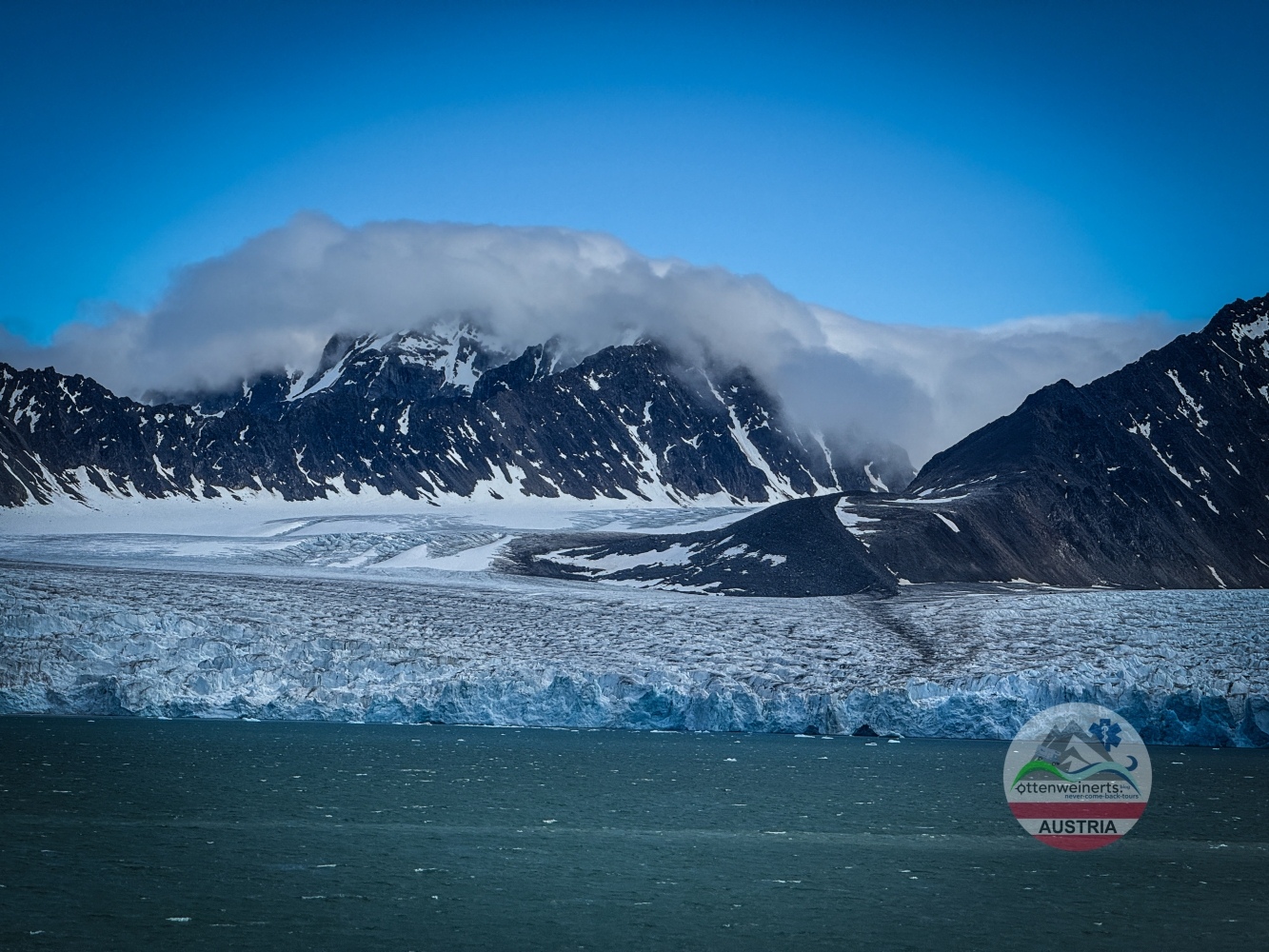
Nach dem Mittagessen folgt eine Zodiactour zum Monacobreen, dem Monaco-Gletscher, benannt nach Prinz bzw. Fürst Albert von Monaco, der Ende des 19. / Anfang des 20. Jhds mehrere Spitzbergen-Expeditionen finanzierte und auch selbst teilnahm. Wir haben wieder Glück mit dem Wetter, erst gegen Ende der Tour beginnt es leicht zu regnen, aber da sind wir schon fast zurück bei unserem Schiff. Nach der abendlichen Zusammenfassung des Tages hören wir von Marco Basics der Glaziologie, und dann ist wieder Ornithologe Simon dran, diesmal erzählt er uns einiges über Skuas, die großen Raubmöwen.

Nach dem Abendessen überqueren wir den 80. Breitengrad bei Moffen Island, wo sich mehrere kleine Herden Walrosse am Strand ausruhen – haben wir auch noch nie in freier Wildbahn gesehen – das entschädigt uns für den „Eisbärfelsen“ von heute früh.

Friday, July 5th – No polar bear in Texas

At 6:45 a.m., our expedition leader Marcel´s lovely voice gets us to jump out of our beds – a polar bear is in sight. Half asleep, we put some warm clothes on, pick up the cameras and make our way to the deck. One of the guides has proof – a photo on his camera, and he points in the direction where the bear is supposed to be. I actually spot a yellowish spot in the white snow, and I hit the button on the canmera many times. Afterwards we admire the many, many pictures of …. the pretty yellowish rock in the snow – the polar bear was long gone.

After breakfast, we take the zodiacs for a landing at “Texas Bar”, a trapper hut from 1927. There is no connection with Texas whatsoever, and it´s also not a bar – the builders of the hut were just having fun. But there are some alcohol bottles on the shelves inside the hut, most of them still containing liquids. We take a walk, get to see purple saxifrages and a red-throated diver – very relaxed because he is very well camouflaged, only the red coloration on his throat is visible. The skuas on the other hand are very annoyed, flying attacks on one of our groups – maybe they got too close to their nest.

Then we have the opportunity for a polar plunge, which turns out to be a polar swim rather than a plunge – we have to undress at shore, walk into the water until it´s deep enough and then swim – and that is much harder than the plunge directly from the zodiac into the icy waters of Antarctica last year. Doesn´t matter, it´s probably my one and only chance to go swimming so close to the North Pole, so off with clothes and into the water. Wasn´t so bad, by the way, just my toes are feeling a bit numb for the rest of the day. Sigi has a good excuse – he is responsible for documenting the whole endeavor.

After lunch, we go on a zodiac cruise towards the Monaco glacier, named after Prince Albert of Monaco who financed and also accompanied several expeditions to Spitzbergen around the turn of the last century. We are in luck with the weather again, it starts raining at the end of our tour when we are almost back at the ship. After today´s recap, Marco from Italy presents a lecture about the basics of glaciology, and ornithologist Simon talks about Skuas, the huge predatory gulls.

After dinner, we cross 80° latitude near Moffen island, where several groups of walruses are napping at the shore – we have never seen walruses in their natural habitat, that sort of compensates this mornings´ “polar bear rock”.

240704 – in der nördlichsten Siedlung der Welt / the world´s northernmost community #oceanwideexpeditions >

Über Nacht haben wir die Strecke bis in den Krossfjord an Spitzbergens Westküste zurückgelegt. Heute morgen gibt es zuerst Frühstück mit Aussicht auf den Lilliehookbreen (Gletscher) bei strahlendem Sonnenschein, und dann noch weitere verpflichtende Briefings: Richtiges Verhalten im Zodiac (nicht aufstehen ohne den Fahrer zu fragen), Regeln für den Landgang (nichts hinterlassen, nichts mitnehmen) und was tun bei Eisbär-Sichtungen (nicht anlocken, nicht streicheln). Vor dem Mittagessen bekommen wir unsere Leih-Gummistiefeln ausgefolgt, die wir dann am frühen Nachmittag im Kingsfjord das erste Mal benötigen.

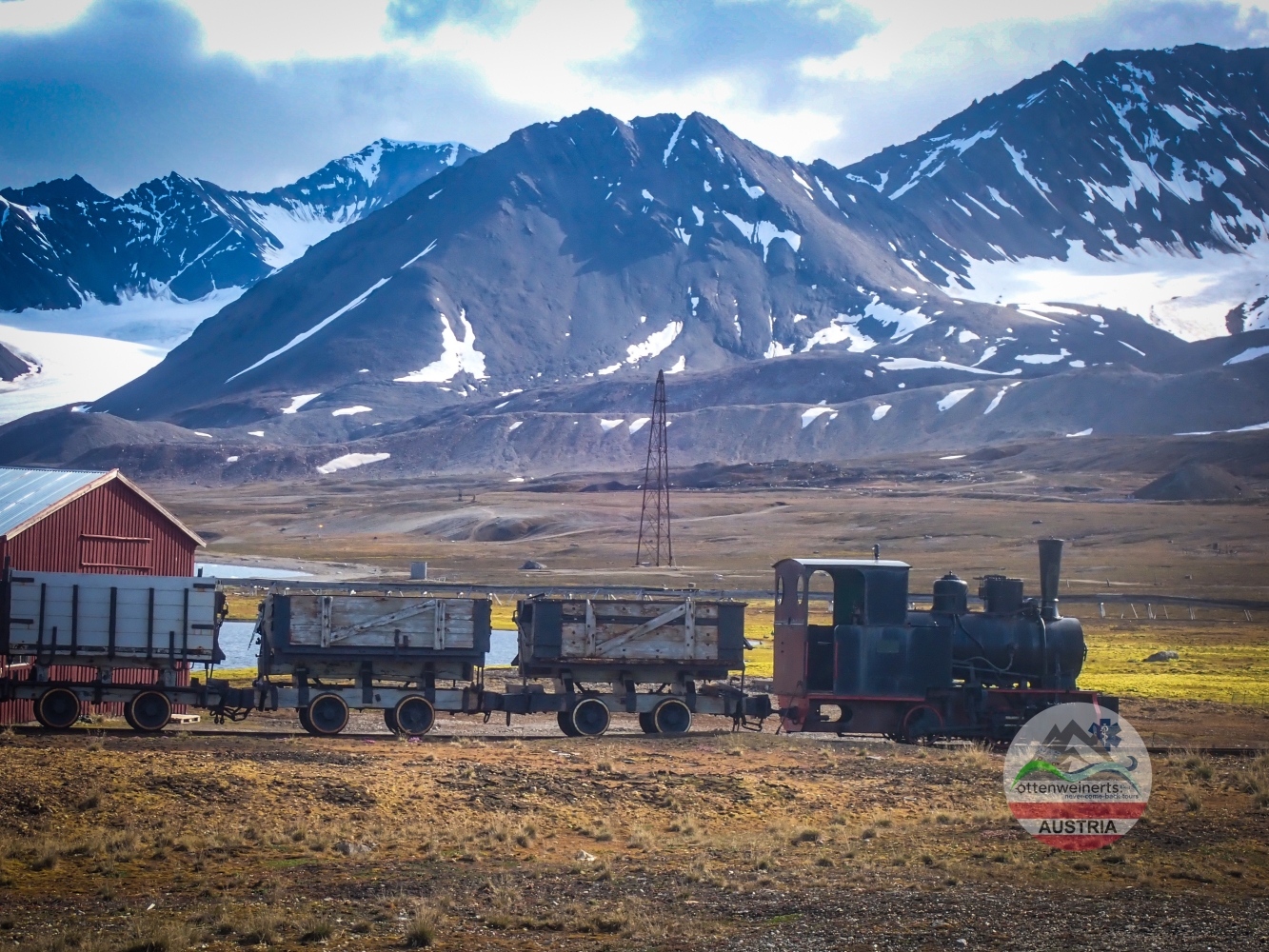
Mit den Zodiacs landen wir in Ny-Ålesund, die nördlichste Siedlung der Welt, einst als Bergbausiedlung gegründet; die alte Lokomotive für den Kohletransport steht noch hier. Ein schweres Grubenunglück bedeutete 1963 das Ende des – ohnehin nicht sehr rentablen – Kohlebergbaus. Heute arbeitet hier eine internationale Wissenschaftergemeinschaft an Forschungsgebieten im Bereich Klima und Umwelt, Atmosphäre, marines Leben und Ozeanographie. Für unsere chinesischen Mitreisenden ist ein Selfie vor der chinesischen „Yellow River Research Station“ natürlich ein Muss.

Wir wandern durch die kleine Ortschaft mit knapp unter 200 Bewohnern (zumindest jetzt, im Polarsommer), schauen in das alte Postamt (leider gibt’s den alten Poststempel nicht mehr, weil Touristen ihre Reisepässe damit gestempelt haben – hätten wir natürlich nie getan, niemals, wir doch nicht…….), und kaufen ein paar Souvenirs im nördlichsten Shop der Welt, wo man schon weit vorausplant: auf den T-Shirts steht Ny-Alesund, 79° nördliche Breite – das wird aufgrund der Plattentektonik in ein paar Jahrmillionen auch zutreffen. Jetzt ist die korrekte Verortung 78°55´, und damit etwa 9 km vom 79. Breitengrad entfernt.

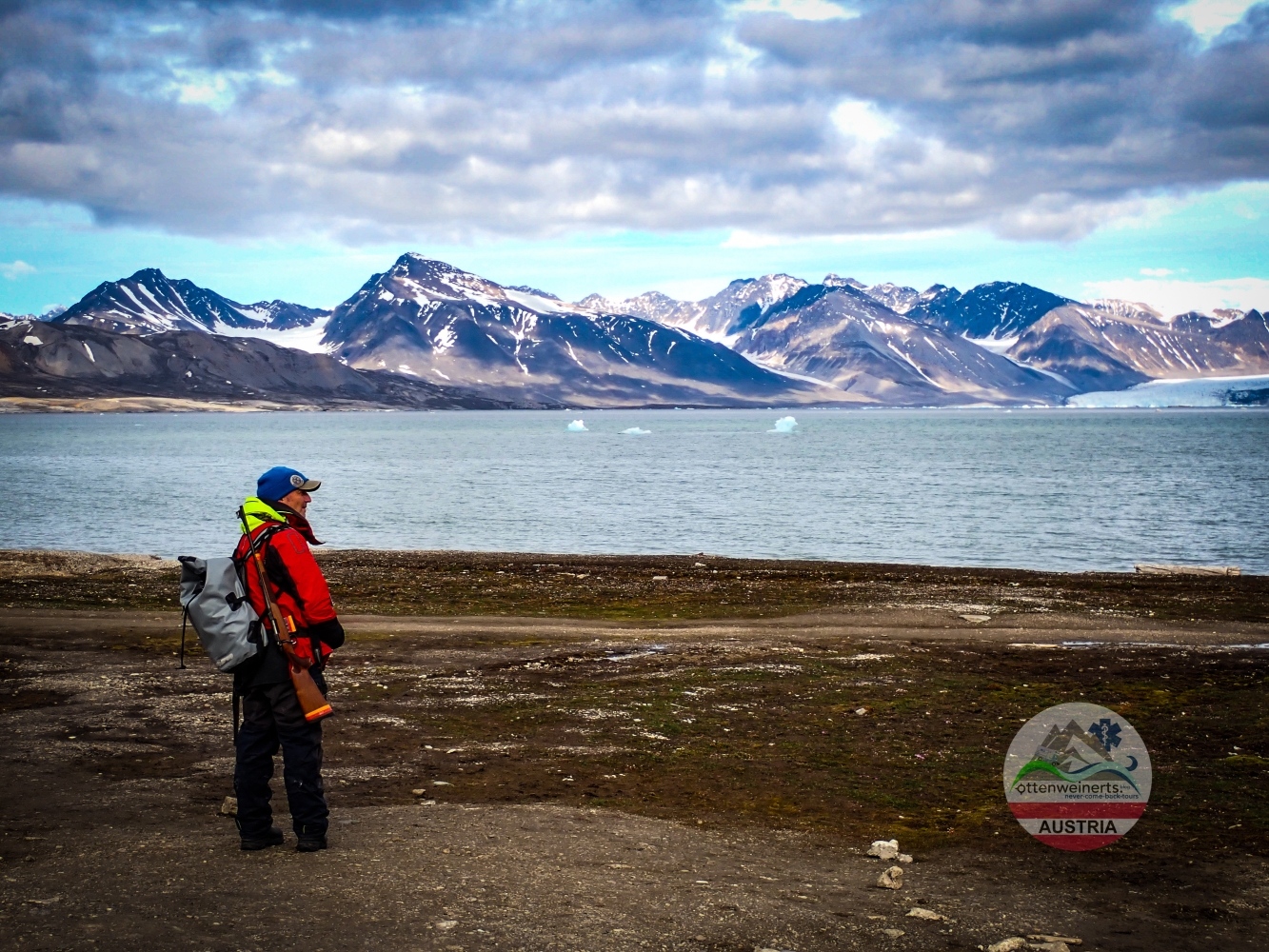
Bei der Büste von Roald Amundsen sammelt sich die Gruppe, um dann geschlossen zum Amundsen-Mast zu marschieren, an dem die Luftschiffe „Norge“ und „Italia“ für die Nordpolexpeditionen 1926 und 1928 vor ihrem Start verankert waren. Der Mast liegt außerhalb der sicheren Zone, daher sind unsere Guides mit Gewehren bewaffnet, für den Fall eines unvorhergesehenen Eisbär-Kontakts. Und im Hintergrund grasen friedlich ein paar Rentiere – übrigens: Rentierbullen tragen ihr Geweih im Sommer, im Herbst werfen sie es ab. Rentierkühe dagegen sind im Winter mit Geweih bewaffnet – also die Rentiere, die Santas Schlitten ziehen, sind lauter Damen!!

Am Rückweg, immer auf den gekennzeichneten Wegen, um die empfindliche Tundra-Flora nicht zu zertrampeln und um brütende Vögel nicht zu stören, erfahren wir im Museum noch mehr Details über die von hier gestarteten Expeditionen sowie über das Leben in diesem abgeschiedenen Ort. Und in der Nähe der Hundebehausungen sehen wir Wissenschafter bei der Arbeit – eine Küstenseeschwalbe wird eingefangen, vermessen, gewogen und beringt – der Rest ihrer Familie ist ziemlich empört und fliegt laut schimpfend Angriffe auf die Forscherin.

Nach der allabendlichen Zusammenfassung der Ereignisse des Tages mit Blick auf den Plan für morgen hören wir noch zwei Kurzvorträge: William aus Frankreich berichtet über Salomon August Andree, der 1897 beim Versuch, mit seinem Ballon zum Nordpol zu fahren, umkam; und von Simon aus Schottland erfahren wir Wissenswertes über Arctic Terns, also Küstenseeschwalben – genau die verteidigungsfreudigen Vögel, die wir nachmittags beobachten konnten.

THURSDAY, July 4th – the world´s northernmost community

In the night, we reached the Krossfjord at Spitzbergen´s west coast – we are having breakfast in front of the magnificent Lilliehook Breen (Glacier), and then there are some more mandatory briefings: how to behave in a zodiac (don´t get up without asking the driver), landing rules (don´t leaving anything, don´t take anything) and polar bear rules (don´t lure them, don´t try to cuddle). After that, it´s boots party – we get our borrowed rubber boots which we will need for the first time in the afternoon in Kingsfjord.

The zodiacs transport us to Ny-Ålesund, the world´s northermost community and another former coal mining town; the old locomotive and some lorries are still visible. A tragic mining accident in 1963 meant the end of the – anyway not very profitable – coal mine. Today, Ny-Ålesund is an international research station where experts from all over the world live and research in the fields of climate and environment, atmosphere, marine life and oceanography. And all of the Chinese guests on board our ship had to take selfies in front of the Chinese “Yellow River” research station.

We stroll through the small village with almost 200 inhabitants (at least now, during the summer), look into the old post office (unfortunately the old postmark is gone because tourists stamped their passports with it – we would never have done that, never ever, of course not ….), and we buy some souvenirs in the northernmost souvenir shop which is fit for the future: the T-Shirts read “Ny-Ålesund, 79° North” – which will be true in a few million years because of the plate tectonics. Now, the correct geographic position is 78°55´ and therefore about 5,6 miles south of latitude 79° north.

Then, we gather at the bust of Roald Amundsen and walk as a group to the Amundsen mast, where the airships “Norge” and “Italia” were moored before their start towards the North Pole in 1926 and 1928 respectively. The mast is located outside the safe perimeter, so our guides are carrying rifles in case of an unexpected meeting with a polar bear. But we see only some reindeer grazing in the background; by the way: male reindeer have their antlers in summer and loose them in autumn. Female reindeer on the other hand, get theirs in autumn and carry them all winter. Therefore, the reindeer pulling Santa´s sleigh – they are all girls!!!

On the way back, always on the marked paths in order not to trample the delicate vegetation or disturb nesting birds, we visit the local museum to learn more about the expeditions which started from here and about life in this secluded place. Near the dog kennel, we see researchers at work – a captured artic tern gets measured, weighed and a ring is put on its leg. The rest of the tern family is rather annoyed, flying heavy attacks on the researcher.

In the evening, after today´s recap, we hear two very interesting lectures: William from France tells us the story of Salomon August Andre, who died trying to reach the North Pole with his balloon in 1897; and Simon from Scotland informs us about Arctic terns – exactly the defensive birds we could watch in action this afternoon.

240703 – Unter Tage und aufs Wasser / Into the mountain and onto the water #oceanwideexpeditions >

Wir starten heute unter Tage, im Dunklen – mit der Besichtigung der „Gruve 3“, einer von insgesamt sieben hier existierenden Kohlegruben. Die Kohlevorkommen hier waren die Ursache für die Gründung von Longyearbyen im Jahre 1906, und der Name stammt vom Gründer, dem Amerikaner John Munroe Longyear. Die Kohle hat einen Reinheitsgrad von 97%, allerdings verlaufen die Flöze horizontal und mussten manuell und im Liegen abgebaut werden. Wir durften in einen Stollen hineinkriechen, 78 cm hoch, und das ist bereits ein Luxusstollen – der niedrigste Stollen war nur 38 cm hoch – unvorstellbare Arbeitsbedingungen!

In der Grube 3 befindet sich auch das AWA, das Arctic World Archive, eine internationale Lagerstätte für Dokumente aller Art, die für künftige Generationen erhalten bleiben sollen. An einer weiteren Lagerstätte kommen wir bei der Rückfahrt von der Grube vorbei, dem „Global Seed Vault“. Hier werden Saatgutproben gelagert, vor allem von landwirtschaftlichen Nutzpflanzen, um im Falle einer weltweiten Katastrophe die Artenvielfalt zu erhalten.

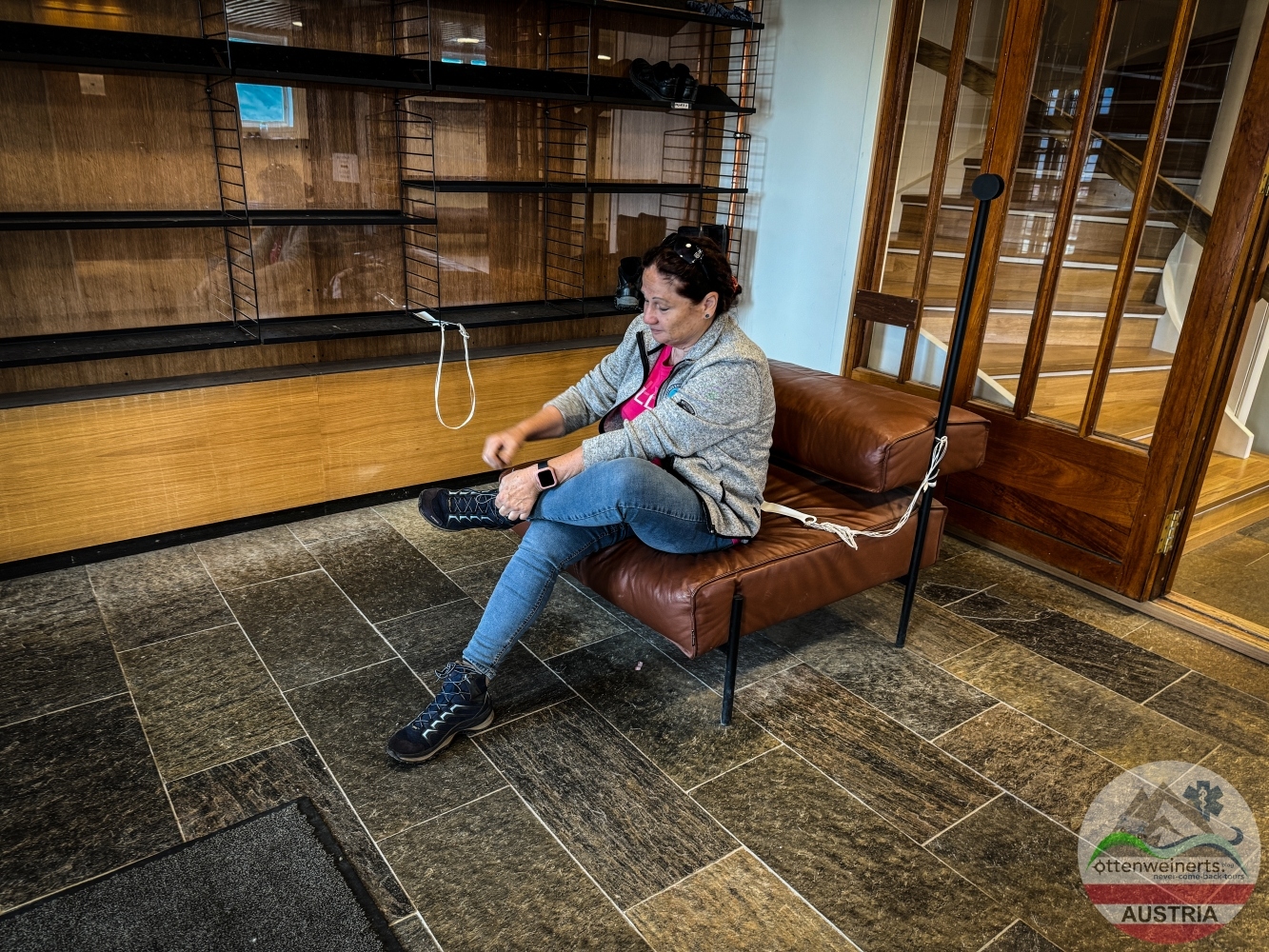
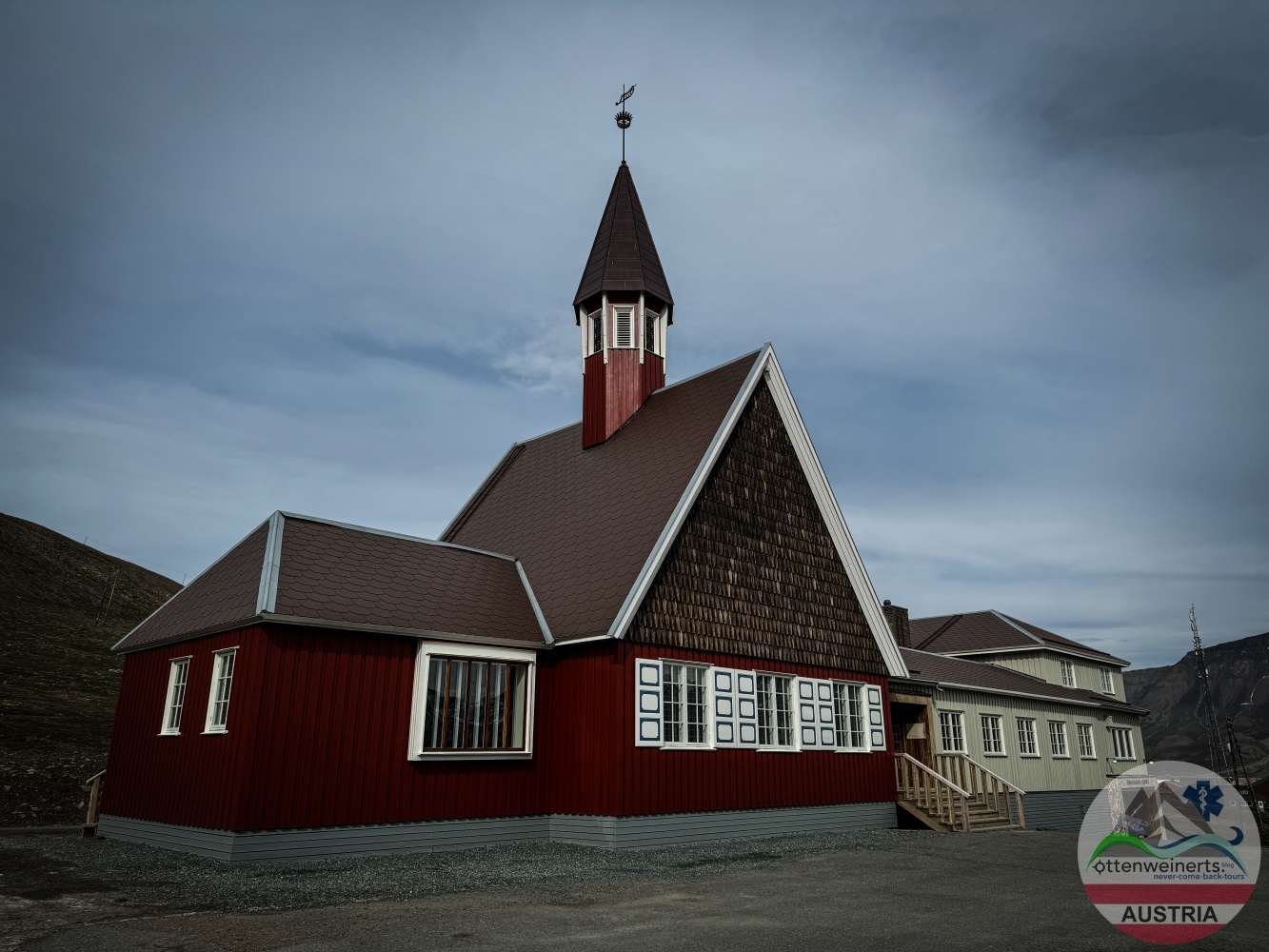
Unser freundlicher Busfahrer lässt uns dann direkt bei der Kirche von Svalbard aussteigen. Dies ist wohl eines der ungewöhnlichsten Gotteshäuser, das wir je besucht haben – für Besichtigungen offen 24/7, man muss die „Schühe“ ausziehen, und es gibt einen gemütlichen Versammlungsraum mit einem großen Kamin, und einen Tisch mit Kaffee und Keksen. Ein echtes Gemeindezentrum – das findet auch die Familie Kurzschnabelgänse mit ihrem flauschigen Nachwuchs, gleich hinter der Kirche.

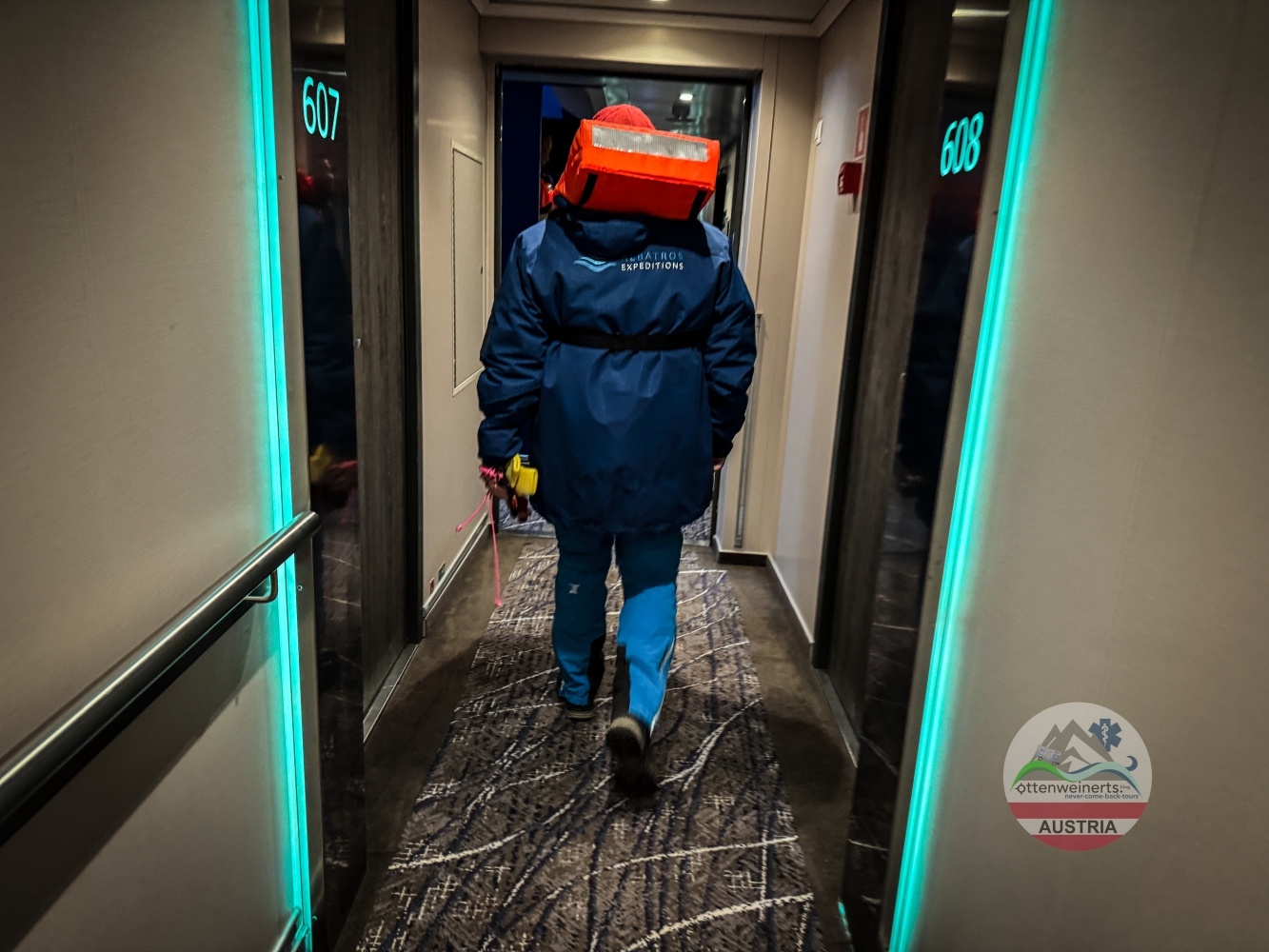
Dann ist es auch schon Zeit, um am Schiff einzuchecken. Wir beziehen unsere Kabine, anschließend geht es zum verpflichtenden Safety Briefing, mit „evacuation drill“ im vollen Outfit mit angelegten Schwimmwesten (SEHR unkomfortabel – aber wir werden sie ja nicht brauchen – hoffen wir). Beim anschließenden Willkommenscocktail-Empfang gibt uns Albert, der Hotelmanager, die ersten Informationen und stellt uns Kapitän Artur und das 23köpfige Expeditionsteam mit Teamleader Marcel vor – währenddessen legt unser Schiff völlig unbemerkt und ganz leise ab – wir sind am Weg zu unserem Abenteuer Arktis.

WEDNESDAY, July 3rd – Into the mountain and onto the water

We start our day by going underground into the darkness, visiting “Gruve 3”, von seven coal mines here around Longyearbyen. The local coal deposits were the reason why Longyearbyen was founded in 1096, and it was named for its founder, the American John Munroe Longyear. The coal here is 975 pure which is excellent, but the coal seams run horizontally, so the workers had to lay down and extract the ore manually. We could crawl into one of the tunnels, only 31 inch high, but that was luxury already – the lowest tunnels was only 15 inch in height – unimaginable working conditions.

Deep within the mine, there is also the AWA, the Arctic World Archive, an international deposit for documents of all kinds which shall remain here for generations to come. On the way back from “Gruve 3”, we pass another deposit, the “Global Seed Vault” where seed samples are stored, mainly from agricultural crops in order to maintain biodiversity in case of a global catastrophe.

Afterwards the friendly bus driver drops us right in front of the Svalbard church, and this is one of the most unusual Christian places of worship we have ever visited: open 24/7, you have to take of your shoes, and there is a cozy meeting room with a huge open fire place and a table with coffee and cookies – a real community center. And behind the church, we find a pair of pink-footed geese with their fluffy chicks.

Then, finally, it´s time to check in on our ship, the “Hondius”. We move into our very nice cabin, then we have to attend the mandatory safety briefing including evacuation drill with our life vests on (VERY uncomfortable, but we won´t be needing them, we hope). After that, at the welcome cocktail reception, Hotel manager Albert gives us some information about the life on the ship and introduces Captain Artur and the expedition team, consisting of 23 experts, led by Marcel. Meanwhile, our ship has left the harbor, very quietly and totally unnoticed – we are on our way to our Arctic Adventure.
230917 – Ein paar Zahlen für unsere Statistikfreunde – some numbers for our friends who like statistics >

Wir waren 500 Tage und 499 Nächte unterwegs – wo haben wir die Nächte verbracht:

Our adventure lasted 500 days and 499 nights – where did we spend the nights:

  • in Hotels: 23 
  • auf offiziellen Campingplätzen – at official campgrounds: 114
  • auf informellen Übernachtungsplätzen (Tankstellen, Shoppingcenter oder Ketten wie Walmart in den USA, oder Restaurants wie Cracker Barrel) – informal camp sites (gas stations, shopping centers like Walmart, restaurants like Cracker Barrel: 255
  • freies Stehen – wild camping: 67 
  • privat – private: 24 (inklusive – including AirBnB)
  • am Schiff – on board the ship: 15
  • im Flugzeug am Heimflug – on the plane on the flight home: 1

Besuchte Länder– visited countries: 19 (eigentlich 20, wenn man das britische Antarktis-Gebiet Port Lockroy mitrechnet – 20, if you count the British Antarctic Territory of Port Lockroy)


Grenzübertritte – border crossings: 

  • offiziell – officially 31 (manche Länder mehrfach besucht – we visited several countries more than once: 2x Brasilien / Brazil, 3x Uruguay, 4x Chile, 7x Argentinien / Argentina); 
  • für die Antarktis-Reise haben wir Argentinien verlassen und waren in internationalen Gewässern unterwegs – for the Antarctic adventure we left Argentina, cruising through international waters; 
  • für das britische Antarktis-Gebiet Port Lockroy gab es keine Ein/Ausreise-Formalitäten – there were no immigration formalities for the British Antarctic Territory at Port Lockroy

Aufenthaltsdauer pro Land – days per country

  • Der längste Aufenthalt entfiel auf Argentinien mit insgesamt 118 Tagen bei 7 Besuchen, der kürzeste auf Costa Rica mit leider nur 4,5 Tagen (weil wir schnell nach Panama mussten wegen der Verschiffung nach Kolumbien); the country where we spent the most days was Argentina with 118 days and 7 visits; the shortest visit was in Costa Rica with only 4,5 days (we had to hurry to Panama to ship our Brave Camper to Colombia)

Tage pro Land – days per country:

  • Kanada / Canada: 11
  • USA: 95
  • Mexiko / Mexico: 25
  • Belize: 8
  • Guatemala: 7
  • Honduras: 7
  • Nicaragua: 6
  • Costa Rica: 4,5
  • Panama: 10,5
  • Kolumbien / Colombia: 26
  • Ecuador: 15
  • Peru: 26
  • Bolivien / Bolivia: 11,5
  • Paraguay: 15,5
  • Brasilien / Brazil: 58,5
  • Uruguay: 26,5
  • Argentinien / Argentina: 118
  • Chile: 18,5
  • Antarktis / Antarctica: 10

Zurückgelegte km – miles we have been driving:

  • Insgesamt sind wir 83.080 km gefahren (da fehlt noch Hamburg-Wiener Neudorf) – we drove a total distance of 51.634 miles (without the last part, from Hamburg to Wr. Neudorf)

Km pro Land – miles in each country:

  • Kanada / Canada: 866 km / 538 miles
  • USA: 23.753 km / 14.763 miles
  • Mexiko / Mexico: 4.355 km / 2.707 miles
  • Belize: 579 km / 360 miles
  • Guatemala: 712 km / 442 miles
  • Honduras: 1.159 km / 720 miles
  • Nicaragua: 526 km / 327 miles
  • Costa Rica: 667 km / 414 miles
  • Panama: 885 km / 550 miles
  • Kolumbien / Colombia: 3.189 km / 1.982 miles 
  • Ecuador: 1.436 km / 892 miles
  • Peru: 4.296 km / 2.670 miles
  • Bolivien / Bolivia: 1.920 km / 1.193 miles
  • Paraguay: 2.500 km / 1.554 miles
  • Brasilien / Brazil: 9.982 km / 6.204 miles
  • Uruguay: 3.350 km / 2.082 miles
  • Argentinien / Argentina: 20.184 km / 12.544 miles
  • Chile: 2.901 km / 1.803 miles
  • Antarktis: gar nix  / zero 

Zurückgelegte Schritte: 3.740.600 – steps we walked

Zu Fuß zurückgelegte km: 2.550,56 km – 1.585 miles on foot

Geradelt: nur 68,5 km (das nächste Mal lassen wir die Räder gleich daheim) – only 42,57 miles on our bicycles (next time we´ll leave them at home)


Spritverbrauch – diesel consumption and mileage: 

  • über 7.000 Liter Diesel (um genau zu sein: 7.359,878 Liter – in vielen Ländern zeigen die Zapfsäulen auf 3 Kommastellen an)
  • plus mehr als 1.400 Gallonen Diesel (1.417,195 Gallonen – in den USA, Belize, Guatemala, Ecuador und Peru wird in Gallonen berechnet)
  • umgerechnet gesamt 12.724,522 Liter bzw. 3.361,462 Gallonen Diesel
  • das bedeutet einen durchschnittlichen Verbrauch von 15,315 Liter auf 100 km – eigentlich ganz ok – wir können stolz sein auf unser Krasses Pferd
  • we needed more than 7.000 liters Diesel (exactly 7.359,878 liters – in many countries the diesel pumps showed three numbers after the coma)
  • plus, more than 1.400 gallons of diesel (1.417,195 to be exact – the US, Belize, Guatemala, Ecuador and Peru are using gallons)
  • in total: 12.724,522 liters respectively 3.361,462 gallons of diesel
  • this means an average consumption of 15,315 liters for 100 km, or – for our friends who are used to gallons and miles: we got on average 15,357 miles out of one gallon diesel, which is more than ok for our Brave Camper

Nächste Woche gibt´s wieder einen Beitrag – bleibt dran!

There will be another info post next week – stay tuned!

230827 – Noch ein Sonntag in Buenos Aires >

Sonntag / Sunday, August 27, 2023
Tag 497 – Noch ein Sonntag in Buenos Aires

Es ist sonnig, halbwegs warm und Sonntag – wieder Flohmarkt in San Telmo. Wir bahnen uns einen Weg durch die Marktstände und die Besucher Richtung Rio Dique, wo die Fregatte Sarmiento auf Besucher wartet. Das ehemalige Schulschiff lief 1899 auf ihre Jungfernfahrt aus und absolvierte bis 1939 insgesamt 39 Ausbildungsreisen in alle Welt, dann war es bis 1960 in argentinischen Gewässern unterwegs. 1961 wurde es in ein Museumsschiff umgewandelt; leider sind derzeit Teile wie etwa die Kapitänskajüte wegen Renovierung nicht zugänglich.

Nach dem Besuch am Schiff geht es zurück Richtung Flohmarkt. Wir kommen an der Casa minimal vorbei, dem schmalsten Haus von Buenos Aires, erbaut Anfang 19. Jhd. Ein Stückchen weiter, am Flohmarkt, kaufen wir dann doch das Buch, das wir letzte Woche gesehen haben – ein Fachbuch über argentinisches Blechspielzeug von 1900 bis 1970, im Handel vergriffen, auch online nicht erhältlich, kleine Auflage, dementsprechend teuer. Aber wir wissen, dass wir dieses Buch wahrscheinlich nie wieder finden werden. Also heute Geld ausgeben oder ab morgen ärgern. Zwei schöne Blechschilder und eine Holzambulanz laufen uns auch noch zu.

Wir bringen die Beute in unser Apartment, machen Mittagspause und überlegen dann, was wir uns noch anschauen wollen. Es gäbe in der Nähe noch Museen, aber das Wetter ist zu schön. Also steigen wir in den Bus und fahren zum Eco-Parque, dem zoologischen Garten. Eigentlich Ex-zoologischen Garten – die meisten Gehege sind leer und viele Gehwege sind abgesperrt, aber Pfaue, Enten und Gänse, Maras (Pampashasen) und sogar Bisamratten laufen uns vor die Füße. Wir können uns das nicht erklären und fragen eine der netten Parkwärterinnen. Es stellt sich heraus, dass sich der Zoo umorientiert und auf Schutz, Zucht und Auswilderung gefährdeter autochthoner Arten ausrichtet. Daher sind viele Tiere bereits in Schutzgebiete in Argentinien und im Ausland übersiedelt. Die Elefanten reisen demnächst in ein Reservat in Mato Grosso, Brasilien, auch die Tapire bekommen ein neues Zuhause. Die Riesenotter dagegen sollen hier Nachwuchs produzieren, der dann in die Ibera-Sümpfe ausgewildert werden soll. Die Giraffen und das Kamel dagegen dürfen für den Rest ihres Lebens hier bleiben. Der Park wird umgestaltet, Pfaue, Enten, Gänse und Fische dürfen bleiben, und die Maras sowieso – die kümmern sich um die Rasenpflege.
Wir machen uns auf den Heimweg, und versuchen ein letztes Mal unser Glück bei der Iglesia y Convento de San Francisco und der Capilla San Roque, die bis jetzt immer geschlossen hatten. Heute Abend hat zumindest die Kapelle offen, Messe wird gelesen, aber die wunderschöne Franziskanerkirche ist nach wie vor zu – durch das große Glasportal sehen wir eingepackte Heiligenstatuen – also wegen Renovierung geschlossen.

Nach dem Abendessen ziehen wir nochmals los. Wir haben die ganze Woche im Internet nach Tango-Shows gesucht, haben auch viele gefunden, konnten uns aber zu nichts entschließen. Gestern abend sehen wir zufällig das La Ventana, nur einen Block von unserem Apartment entfernt und können online „Show only“ buchen, also ohne Abendessen und Transfer. Und diese Show ist wirklich exzellent – die Musiker fantastisch, die beiden Sänger ausgezeichnet, und die drei Tangopaare wirbeln ihre Beine in schwindelerregendem Tempo herum. Das Publikum ist international, von Brasilien und Uruguay über USA bis Italien und sogar Österreich  dementsprechend ist das Programm gestaltet. Als „Evita“ auf der Bühne auftaucht und „Don´t cry for me, Argentina“ singt, bleibt kein Auge trocken. Der schönste Teil für uns aber war die Folklore-Gruppe – zu Klängen von Panflöte und Gitarre ziehen auf der Riesenleinwand im Hintergrund argentinische Impressionen vorbei – genau das, was wir in unseren insgesamt 4 Monaten Reise durch dieses großartige Land gesehen haben – Anden und Atlantik, Kakteenwüste und Dörfer mit geduckten, weißen Adobe-Häuschen, Pampa und weiter Horizont mit Kondoren. Da kommen auch uns ein paar Abschiedstränen – übermorgen geht es schon nach Hause.

Day 497 – Another Sunday in Buenos Aires

It is sunny, acceptably warm, and Sunday – flea market again in San Telmo. We make our way through the market stalls and the visitors towards Rio Dique, where the frigate Sarmiento is waiting for visitors. The former school ship began her career in 1899, traveling 39 times all over the world until 1939; then she served as school ship in Argentinian waters until 1960. In 1961, she was turned into a museum; unfortunately, some parts like the captain´s quarters are closed for renovation right now.

Then, we return to the flea market, passing by Casa Minima, the smallest house of Buenos Aires, built at the beginning of the 19th century. At the flea market, we find ourselves standing at the book stall where we saw a very special book last week – a book about Argentinian tin plate toys from 1900 to 1970, limited edition, no available in the book stores anymore, and not available online, either. And we know that we probably will never find that book ever again. So, it´s “spend money today or cry tomorrow”. We also find a nice handmade wooden ambulance and two tin plate signs.
We carry our booty back to our apartment; after lunch break, we need to decide what to do. There are several museums around, but the weather is too nice to be inside, so we take the bus to the Eco-Parque, the zoological garden. Well, the former zoological garden – most of the enclosures are empty, many walkways are cordoned off, but peacocks, ducks and geese, maras (pampas hares) and even muskrats cross our way. We are puzzled and ask one of the nice park guards. She explains to us that the zoo has changed its goals and projects, concentrating on protection, breeding and releasing endangered autochthon Argentinian fauna. Therefore, many animals have been relocated to reservations in Argentina and also other countries. The elephants will find move to an animal reservation in Mato Gross, Brazíl, very soon, the tapirs will also find a new home. The giant otters on the other hand, are supposed to produce off-spring here, which will be released into the Ibera swamps in the north of Argentina. The camel and the giraffes are allowed to stay for the rest of their lives. The park will be remodeled; the peacocks, ducks, geese and the fish in the ponds will stay, and the maras of course – they are taking care of the lawn.

On our way home, we try our luck one last time at the Iglesia y Convento de San Francisco – Capilla San Roque, which we have never seen open all week. Now, at least the chapel is open for mass, but the beautiful San Francisco church is still closed. Through the big glass portal, we can see covered statues standing in the front area – the church is obviously closed for renovation.

After dinner, we leave again – we have been searching for Tango shows all week, found many all-around Buenos Aires but couldn´t make a decision. Yesterday evening, by chance, we passed by the “La Ventana” on our way home, just a block away from our apartment. It is possible to book “show only” online – without dinner and transfer. And the show is really excellent – fantastic musicians and singers and three pairs of incredible tango dancers. The auditorium is international, from Brazíl and Uruguay to the US and Italy, and even Austria  and the program is adjusted to the expectations – all of a sudden “Evita” appears on stage, singing „Don´t cry for me, Argentina “– the crowd goes wild. But the best part for us was the folklore ensemble – pan flute and guitar accompany images of Argentina, on a big screen in the back. These are the landscapes we have seen and the memories we have made during our 4 months travel through this beautiful country – Andes and Atlantic, cactus desert and low, white adobe houses, pampa and endless horizon with condors flying. We have to hold back the tears – the day after tomorrow we are going home.

Route 230827 – Buenos Aires

An Bord der Ocean Victory – Feb 27 to March 9, 2023 – Ushuaia – Antarctica – Ushuaia


Sarah & Simon – the girl from Wales and the lad from – then still British – Malta, who decided to move to Australia more than 40 years ago. We will definitely come and visit you on our Australia tour (when? Don´t know yet) / das Mädchen aus Wales und der junge Mann aus dem – damals noch britischen – Malta, die vor mehr als 40 Jahren nach Australien ausgewandert sind. Wir werden Euch auf jeden Fall besuchen kommen auf unserer Australien-Reise (wir wissen bloß noch nicht, wann)


Michael – who lives in Hawaii where he is engaged in social work; a man with exquisite taste in fashion, celebrating his 25th birthday for the 25th time while on this cruise / lebt auf Hawaii und engagiert sich in Sozialarbeit; stets exquisit gekleidet, feiert er während der Kreuzfahrt seinen 25. Geburtstag. Zum 25. Mal. 🙂


Rosa – the charming Chilean diplomat who lives and works in Ushuaia now – it was so nice seeing you again after the cruise! / die charmante chilenische Diplomatin lebt und arbeitet zur Zeit in Ushuaia. Wir haben uns so gefreut, Dich nach der Kreuzfahrt nochmals zu treffen!


Graciela & Harald – Argentinian tour guide Graciela and “same-first-name-as-the-Norwegian-King” Harald from Oslo, living in Salta – we will try to make it to Salta in time before you leave for Norway end of April! / die argentinische Touristenführerin Graciela und “ich-hab-den-gleichen-Vornamen-wie-der-norwegische-König“ Harald aus Oslo leben in Salta. Wir werden uns bemühen, Euch in Salta zu besuchen, bevor Ihr Ende April nach Norwegen fliegt!


Captain Oleg & First Officer Gianmaria – they safely steered the ship through the icy waters of the Antarctic, searching for the best spots for our Zodiac cruises and landing expeditions / sie haben das Schiff sicher durch die eisigen Wasser der Antarktis gesteuert und die besten Orte für unsere Zodiac Ausflüge und Landgänge ausgesucht


Dr. Juan – we visited the charming young physician from Colombia and had a look around the medical facilities on board; the next day he trusted us to take care of these facilities and him, as he needed medical support himself; luckily, this happened on the last day of our cruise / wir haben den charmanten jungen Arzt aus Kolumbien in seinem Bordhospital besucht und geplaudert; am nächsten Tag, als er selbst medizinische Hilfe benötigte, hat seine kleine Klinik und sich selbst uns anvertraut – gut, dass das erst am letzten Tag der Reise passiert ist


Rashida – the Expedition Team Leader from Malaysia, who was always smiling and in a good mood, so that we even forgave her when her lovely voice woke us up at 7 am – shortly after midnight, so to speak / unsere Expeditionsleiterin Rashida aus Malaysia, immer lächelnd und gut aufgelegt, so dss wir ihr sogar verziehen haben, wenn uns ihre liebliche Stimme um 7 Uhr früh aus dem Bett geworfen hat (also kurz nach Mitternacht, quasi)


Thomas – the “gentle giant” from Bavaria, Antarctic expert and ambassador, gained his PhD investigating commercial tourism in Antarctica; he moved to Hongkong and then to Queensland, Australia, where he and his wife own and guard a piece of rainforest / der „freundliche Riese“ aus Bayern, Antarktis-Experte und Botschafter, hat seinen Doktortitel mit der wissenschaftlichen Untersuchung von kommerziellem Tourismus in der Antarktis erworben; er hat in Hongkong gelebt und ist dann nach Queensland, Australien, gezogen, wo er zusammen mit seiner Frau ein Stück Regenwald besitzt und als Schmetterlingsgarten schützt


David – the geologist from Scotland, proudly wearing his kilt on several occasions, has vast Antarctic experience, he even has reached the South Pole; he managed to awaken our interest in geology – or at least he explained the geological facts in a manner that they really seemed interesting / der Geologe aus Schottland, immer wieder mal im Kilt, hat jahrelange Antarktiserfahrung, er hat sogar den Südpol erreicht.; er hat unser Interresse an Geologie erweckt – oder zumindest die geologischen Fakten so präsentiert, dass sie wirklich interessant erschienen


Gui – the ornithologist from France lived and worked at British Port Lockroy Antarctic Base for 4 months; he made the Penguin mating ritual come to life with a very acrobatic show – unforgettable! / der französische Ornithologe hat 4 Monate auf der britischen Antarktis-Basis Port Lockroy gelebt und gearbeitet; mit einer unvergesslichen akrobatischen Show hat uns er das Paarungsritual der Pinguine näher gebracht


Susanne – the forensic toxicologist from the Black Forest, Germany, who took care of the shop on board, has been interested in polar exploration from her youth; she has traveled extensively, including visits to Svalbard / die Deutsche aus dem Schwarzwald, von Beruf forensische Toxikologin, hat unter anderem den Shop an Bord betreut; schon von klein auf an Polarforschung interessiert, hat sie zahlreiche Reisen unternommen, inklusive Besuche in Spitzbergen, Norwegen. 


Carina – the girl from Upper Austria studied marine biology in Belfast, Northern Ireland; she worked as dog sled guide in the Arctic and as whale watching tour guide in Iceland. She presented various lectures on board, about pinnipeds (seals, sea lions and walruses) as well as about cows in the Antarctic /die Innviertlerin hat in Belfast Meeresbiologie studiert, als Schlittenhundeführerin in der Arktis und als Tourguide bei Walbeobachtungen in Island gearbeitet; ihre unterhaltsamen Präsentationen an Bord umfassten so diverse Themen wie Flossenfüßer (also Seehunde, Seelöwen und Walrosse) und „Kühe in der Antarktis“


Antarktika – Karte und Videos >

Unsere Reise in die Antarktis war ein – wenn nicht sogar „DER“ Höhepunkt unserer bisherigen Reise durch Nord-, Mittel- und Südamerika. In den 11 Tagen und Nächten haben wir 3.910 Kilometer mit der Ocean Victory zurückgelegt. Unzählige Eindrücke, hunderte Fotos und Videos, interessante Vorträge, tolle Crew an Bord und vor allem haben wir neue Freunde aus der ganzen Welt gefunden. Wir sind glücklich, dass wir die Gelegenheit hatten, diesen entlegenen Zipfel der Welt sehen und kennenlernen zu dürfen, auch wenn es nur ein winziger Teil war. Und zu guter letzt dürfen wir uns zu der kleinen Schar an Menschen zählen, die alle sieben Kontinente besucht haben.


Our expedition to the Antarctic was one of the highlights – maybe even THE highlight – of our travels through the Americas. In 11 days and 10 nights on the Ocean Victory, we sailed 2.430 miles. It was an incredible adventure with interestings lectures, a fantastic team and crew. We took hundreds of photos and videos, and found new friends from all over the world. We are so lucky to have had the opportunity to see this remote part of the world, even if it was only a tiny bit of it. And last but not least, now we have the privilege of being among those blessed travelers who have visited all 7 continents.


Unsere Reiseroute (aufgezeichnet von unserem GeoTagger) / Our itinerary as logged by our geotagger:

Natürlich dürfen auch einige Videos nicht fehlen / and, of course, some videos:

230309 – Zurück in Ushuaia >

Donnerstag / Thursday, March 9, 2023

Tag 326 / 302 – Zurück in Ushuaia

Heute müssen wir bereits um 5:30 aufstehen (also quasi kurz nach Mitternacht) – was nach nur wenigen Stunden Schlaf noch weniger lustig ist als üblich. Aber wir müssen das Zimmer bis um 7:00 räumen, und Frühstück gibt es auch nur bis um 7:00. Wir verabschieden uns von einigen ganz besonders lieben Mitreisenden, mit denen wir gerne noch mehr Zeit verbracht hätten – Sarah und Simon aus Australien, Michael aus Hawaii, Rosa aus Chile (die in Ushuaia arbeitet), und Graciela und Harald, einem netten argentinisch-norwegischen Pärchen aus Salta. Verabschieden müssen wir uns auch von der Crew – Kapitän Oleg und sein erster Offizier bedanken sich nochmals für unsere Unterstützung gestern – und dem Expeditionsteam unter Rashidahs Leitung.  

Diese Reise war ein großartiges Erlebnis, und wir haben Lust auf mehr bekommen. Da wären zum Beispiel noch die Falklands und Süd-Georgien, oder auf der Nordhalbkugel Grönland, oder auch Svalbard. Schau ma mal!

Dann kommen schon die ersten Busse, die uns zurück in die Stadt bringen. Es ist noch zu früh, um unseren Mechaniker zu kontaktieren, also setzen wir uns ins Tourist Office in die Wärme und nutzen das freie Internet, um die Positionsdaten der Reise und die Emails der letzten 10 Tage herunterzuladen. Gegen Mittag nehmen wir ein Taxi und fahren zum Mechaniker, wo wir unser Krasses Pferd aufgebockt und ohne Hinterreifen vorfinden – Edgardo arbeitet gerade an den Bremstrommeln. Dann zeigt er uns die Ersatzteile, die er für uns besorgt hat, größtenteils original Iveco Teile; und wir haben nach Service und Reparatur doch tatsächlich mehr Ersatzteile als vorher! 

Wir verschieben die letzten Arbeiten am Auto auf morgen, wir müssen noch unseren Frischwassertank auffüllen und den Kühlschrank auch. Dann parken wir uns für die Nacht wieder am Hafen ein. Gerade kommt ein großes Schiff herein, die National Geographic Resolution; dahinter liegt immer noch unseres, die Ocean Victory. Wir lassen die vergangenen Tage Revue passieren, und bemühen uns gleichzeitig, uns nach 10 Kalorien- und erlebnisreichen Tagen mit Luxus-Platzangebot und viel netter Gesellschaft wieder an das Leben zu zweit auf unseren paar Quadratmetern zu gewöhnen.

Day 326 / 302 – Back in Ushuaia

Today, we have to get up at 5:30 a.m. (which for me is shortly after midnight) – after only a few hours of sleep. But we have to clear the room at 7:00 am at the latest, and breakfast is also only available till 7. We say good-bye to some exceptionally nice people – we wish we could spend some more time with them – Sarah and Simon from Australia, Michael from Hawaii, Rosa from Chile (working in Ushuaia) and Graciela and Harald, a lovely Argentinian-Norwegian couple from Salta. We also have to say good-bye to the crew – captain Oleg and his first officer are grateful for our help yesterday – and to Rashida, Thomas and all the other members of the expedition team.

The expedition cruise was a fantastic experience, and we already think about doing another one. The options would be the Falkland Islands / Islas Malvinas and South Georgia, or in the north, Greenland or also Svalbard. We´ll see!

Then the bus comes to transport us back to the city. It is too early to contact our mechanic, so we occupy some seats in the warmth of the tourism office and use the free internet to download the GPS data from our cruise and 10 days’ worth of emails. Around noon, a taxi brings us to the mechanic, where we find our brave camper without rear tires – Edgardo is working on the brakes. Then he shows us the spare parts he managed to get for us, mostly original IVECO parts; now, after service and maintenance, we have even more spare parts than we had before!

We postpone the last necessary works on the vehicle till tomorrow, we have to fill our fresh water tank and our fridge, too. Then we go back to the parking area at the harbor. A large expedition cruise ship is arriving, the National Geographic Resolution; behind this ship we can still see ours, the Ocean Victory. We think and talk about the last 10 days with lots of fun and adventure, lots of calories, lots of space in our suite and lots of nice people around us, trying at the same time to get back to our life in our brave camper – little space and just the two of us.

Route 230309

230308 – Antarktisexpedition Tag 10 – Notfall bei Kap Hoorn >

Mittwoch / Wednesday, March 8, 2023

Tag 325 / Antarktisexpedition Tag 10 – Notfall bei Kap Hoorn

Nach einem späten Frühstück gehen wir zu Davids Vortrag mit dem spannenden Titel „Werden Mineralien aus der Antarktis irgendjemanden reich machen?“ Die kurze Antwort wäre „nein“ gewesen, aber David holt weit aus und kann dieses nein gut begründen – keine Infrastruktur, weiter Transportwege, kein fundiertes Wissen über Vorkommen und Abbaumöglichkeiten. Rohstoffabbau in der Antarktis ist sehr unwahrscheinlich, es wäre ziemlich sicher äußerst riskant und somit finanziell unattraktiv. Bisher hatten wir mit Geologie gar nichts am Hut, aber es ist doch ein interessantes Wissenschaftsgebiet; liegt aber sicher auch am Vortragenden.

Nach dem Mittagessen zieht sich Sigi in unsere Suite zurück, während sich das Schiff langsam dem Kap Hoorn nähert. In der Shackelton-Lounge ist wieder Thomas an der Reihe, mit einem sehr persönlichen Vortrag. Gemeinsam mit seiner Frau hat er in Australien ein Stück küstennahen Regenwald in Mission Beach, North Queensland, Australien, gekauft, und sich verpflichtet, 97% davon auf alle Zeiten als Schutzgebiet zu erhalten. Als er gerade zeigt, was dort alles wächst und gedeiht, kommt Sigi leise in die Lounge und macht Handzeichen – „Einsatz, Notfall, JETZT“. 

Ich denke mir, das gibt´s doch nicht, aber wir werden tatsächlich benötigt – der Schiffsarzt braucht selbst einen Arzt, und zwar dringend. Also monitieren wir den Kollegen im Überwachungsbett, versorgen ihn mit Infusionen und allen nötigen Medikamenten, geben der Brücke Bescheid und übernehmen dann die Krankenstation bis zum Ende der Reise (glücklicherweise schon morgen). Sigi checkt die Notfallausrüstung – die meisten Dinge sind uns gut vertraut – und ich überwache den Patienten. Gottseidank haben wir sonst außer einem COVID-Test und der Ausgabe eines Medikaments keine weiteren Notfälle. 

Wir wechseln einander ab mit der Betreuung des Patienten, damit bekommen wir jeweils abwechselnd wenigstens kurz die Gelegenheit, vom Panoramadeck aus das Kap Hoorn zu sehen. Sigi geht dann zum letzten abendlichen Briefing, wo Rashidah dem Publikum mitteilt, dass unsere Expeditionsfahrt gleich mehrere Rekorde gebrochen hat: 74 TeilnehmerInnen waren Kayak fahren, und 118 sind ins eiskalte Wasser gesprungen – so viele wie noch nie zuvor. Außerdem war es der südlichste Polarsprung bis jetzt, auf 66°01.5´ süd, und wir waren „nur“ noch 1.850 nautische Meilen vom Südpol entfernt.

Dann holt mich der Kapitän auf die Brücke – er hat inzwischen die chilenische Küstenwache verständigt, die ein schnelles Boot schicken wird, um den Patienten nach Puerto Williams, Chile, ins nächstgelegene Krankenhaus zu bringen. Vorher benötigt man noch ein paar Auskünfte, aber die Chilenen sprechen kaum Englisch, und der Kapitän und sein erster Offizier nicht Spanisch. Und somit stehe ich auf der Kommandobrücke unseres Expeditionsschiffes, das Funkgerät in der Hand, und erkläre den chilenischen Kollegen auf Spanisch, was unser Patient vermutlich hat und was inzwischen getan wurde.

Das Schiff fährt Richtung chilenische Gewässer, dem Schnellboot entgegen, als wir plötzlich umdrehen. Das Boot der Küstenwache hat einen Maschinenschaden, sie würden Ersatz schicken, aber das dauert länger, als wir nach Ushuaia benötigen. Unserem Patienten geht es mittlerweile auch deutlich besser, die Medikamente wirken und so steuern wir Ushuaia an, wo der Patient schon erwartet und ins Krankenhaus gebracht wird. Todmüde fallen wir ins Bett, mit dem Funkgerät am Tisch – der letzte Tag ist nicht ganz so gelaufen, wie erwartet.

Day 325 / Antarctic expedition day 10 – Emergency near Cape Hoorn

After a late breakfast, we attend David´s lecture with the interesting title “Will Antarctic minerals make anyone rich?” The short answer would be “no” but David lays out his arguments and there are very good reasons why not – no infrastructure, long and expensive transport, no valid knowledge about mineral deposits and exploitation options. So, mining for minerals in the Antarctic is highly unlikely, it would be very risky and therefore economically unattractive. We haven´t been too interested in geology until know, but it seems to be a very interesting field; and the presenter is very good, too!

After lunch, Sigi retreats to our suite while our ship slowly gets closer to Cape Hoorn. In the Shackelton Lounge, Thomas presents a very personal part of his life. Together with his wife, he bought a piece of land in Mission Beach, North Queensland, Australia – coastal rain forest. And 97% of this land will be protected in a conservation covenant forever. He is just showing us pictures of the flora, when Sigi quietly sneaks in, signaling me “Emergency! NOW!

I can´t believe my eyes, but we are really needed – the ship´s doctor urgently needs a doctor himself. So, we put him into the intermediate care bed, monitor him, apply fluids and the necessary medication, inform the bridge and take over the hospital and the doctor´s duties till the end of the voyage (luckily, tomorrow morning). Sigi checks the mobile emergency equipment, most things are very similar or the same we use at home, and I monitor the patient. Fortunately, there are no other emergencies; we only have to do one COVID test and give out some medication.

We take turns in watching over our patient, so we each get to see Cape Hoorn at least for a few minutes, for some photos from the panorama deck. Sigi then joins the last evening briefing with Rashida who tells us that our expedition cruise broke several records: 74 people went kayaking and 118 jumped into the ice-cold polar waters – more than ever before. And it was the southernmost polar plunge at 66°01.5´ south; our distance to the South Pole was “only” 1.850 nautical miles.

Then the captain calls me to the bridge – he has alerted the Chilean Coast Guard, they will send a fast boat to extract the patient and bring him to the nearest hospital in Puerto Williams, Chile. But first, they need some more information; the Chileans don´t speak much English, and the captain and his first officer don´t speak Spanish. Therefore, I find myself standing on the bridge of our expedition cruiser, with the radio in my hand, talking to a Chilean doctor in Spanish about our patient.

Our ship has already reached Chilean waters, but then, all of a sudden, we turn around. The Chilean coast guard boat has an engine problem – they will send another boat but that would take longer than our journey to Ushuaia. Our patient is doing far better by now, thanks to the medication, so the captain decides to sail directly to Ushuaia, where an ambulance is waiting for our patient to take him to hospital. Incredibly tired, we fall into our beds, with the walkie talkie on the table. The last day didn´t go exactly as expected.

Route 230227 – 230309

230307 – Antarktisexpedition Tag 9 – Drake Passage >

Dienstag / Tuesday, March 7, 2023

Tag 324 / Antarktisexpedition Tag 9 – Drake Passage

Am Morgen scheint die Sonne, der Himmel ist blau und der Wellengang ist erträglich. Vormittags schließen wir uns einer Führung auf der Brücke an. Viele Computerschirme, kaum mehr Papierkram, fast alles elektronisch; während der diensthabende Offizier erklärt und Fragen beantwortet, steuert der Autopilot das Schiff.

Anschließend klettern wir von Deck 7 (die Brücke ist gleich hinter unserer Kabine) hinunter auf Deck 3, um Dr. Juan Felipe, den Schiffsarzt, in seinem Reich zu besuchen, Krankenstation und Apotheke zugleich. Ein Überwachungsbett mit Monitor ist vorhanden, eine gut sortierter Notfallrucksack und eine Auswahl der gängigsten Medikamente inklusive Antibiotika. Und natürlich COVID-Test, viele Schachteln davon. Es gibt Ordinationszeiten Vormittag und Nachmittag, aber im Prinzip ist Dr. Juan ohnehin immer auf Abruf, weil er kein Pflegepersonal zur Unterstützung hat. Die komplette Crew hat zumindest eine Basis-Erste-Hilfe-Ausbildung, einige sind auch Paramedics. Von der Krankenstation geht es gleich zum Brunch, wo uns das Schild „Weiner Schnitzel“ nicht zum Weinen, sondern zum Lachen bringt.

Nach dem Brunch hören wir einen weiteren interessanten Vortrag von Thomas über Tourismus in der Antarktis – ein eher ausgefallenes Thema (das Thomas aber seinen Doktortitel eingebracht hat), aber immerhin gab es bereits 1920 das erste Angebot für Kreuzfahrten in die Antarktis (vom Veranstalter Thomas Cook) – allerdings fanden sich damals noch keine zahlungswilligen Touristen, das dauerte bis 1958. Ab 1966 bot Lars Lindblad regelmäßige Kreuzfahrten in die Antarktis an; er erfand das Lindblad-Model – Kreuzfahrten mit einer zusätzlichen, edukativen Komponente in der Form von Vorträgen (also genau die Art von Reise, die wir unternommen haben). Inzwischen ist die Zahl der Antarktis-Touristen deutlich gestiegen, für die Saison 2022/23 rechnet man mit 100.000 Passagieren auf 50 Schiffen von 46 verschiedenen Veranstaltern; 70.000 dieser Passagiere werden auch an Land gehen, der Rest ist „cruise only“.

Dann sehen wir „Chasing Ice“, einen großartigen, spannenden Dokumentarfilm über den amerikanischen Gletscherphotographen James Balog, der im Rahmen seines „ICE-Project“ Kameras in Grönland, Kanada, Alaska und Montana installierte und so über Jahre hinweg den Rückzug der Gletscher zweifelsfrei belegen konnte – die bis dahin angezweifelte Erderwärmung war somit kein Mythos mehr. Nächster Programmpunkt: ein Vortrag über Leben und Expeditionen des norwegischen Polarforschers Roald Amundsen, der mit gewissenhafter Vorbereitung und minutiös geplanter Expedition als erster den Südpol erreichte. Und dann gibt es noch eine kurze Präsentation zu einer lustigen Anekdote – „Kühe in der Antarktis“. Ein Amerikaner nahm als Marketing-Gag drei gemietete (!) Kühe mit auf eine Fahrt in die Antarktis – eine davon war trächtig, und kurz vor Erreichen der Antarktis wurde Kalb „Iceberg“ geboren. Die Kühe wurden zu Berühmtheiten und bekamen nach ihrer Rückkehr Medaillen verliehen.

Das Wetter ist im Lauf des Tages schlechter geworden, der Wellengang höher, der Himmel ist grau und es bläst ein starker Westwind. Auch heute sind deutlich weniger Passagiere beim Abendessen – sehr schade, denn das indische Buffet ist wirklich gut. Gegen 21 Uhr kommt dann die Durchsage, dass mit stärkeren Schiffsbewegungen zu rechnen ist. Wir mögen uns doch bitte immer mit einer Hand irgendwo festhalten, und wir sollen lose Gegenstände in unseren Kabinen vorm Herunterfallen sichern. Und die Ankündigung war nicht übertrieben – die Wellen werden höher, das Schiff rollt von einer Seite auf die andere, und es knackt und knirscht. Die Geräusche halten mich lange munter, irgendwann gegen 3 Uhr früh schlafe ich dann doch erschöpft ein.

Day 324 / Antarctic expedition Day 9 – Drake Passage

In the morning, the sun is shining, the sky is blue and the waves are not high. After breakfast, we join a guided tour to the ships bridge. There are many screens, almost no paperwork anymore, almost everything is done electronically. And while the officer explains technical details and answers questions, the autopilot is steering the ship.

After the bridge tour we climb from deck 7 (the bridge is right behind our suite) down to deck 3 for a visit with the ship´s doctor, Dr. Juan Felipe, in his realm – infirmary and pharmacy at the same time. There is an intermediate care bed with a monitor, a well-equipped emergency backpack and a wide array of medication including some antibiotics. And COVID tests. Of course – many boxes. The doctor´s office is open some hours in the morning and in the afternoon, but as Dr. Juan is all by himself without any nurse, he is on call all the time. All of the crew have at least a basic first aid training, some of them even more. From the hospital, we proceed directly to lunch, where we find a “Weiner Schnitzel” which tasted like a Wiener Schnitzel.

After brunch, we listen to another of Thomas´s very interesting presentations about tourism in the Antarctic – kind of a rare subject (which helped Thomas achieve his PhD); anyway, the first offer to the public for a cruise to the Antarctic was made by operator Thomas Cook in 1920 – although there weren´t any takers until 1958. In 1966 Lars Lindblad started to offer regular cruises to the Antarctic, and he invented the “Lindblad-model” – adding an educational bonus to the voyage in form of presentations and lectures (exactly what we were enjoying the last 10 days). In the meantime, the number of passengers has risen considerably: expectations for 2022/2023 seasons are 100.000 passengers on 50 different ships from 46 tour operators; 70.000 of these passengers also will land in the Antarctic, the others will do the cruise only. 

Later, we get to see the movie “Chasing Ice”, a thrilling documentarty about a fascinating man, the American glacier photographer James Balog. He installed cameras in Greenland, Canada, Alaska and Montana, and over several years he was able to prove that the glaciers are retreating – global warming was not a myth anymore. Next topic: a presentation about the life and the expeditions of the Norwegian polar explorer Roald Amundsen, who was the first human to reach the South Pole, due to careful planning and preparation. And then something to smile – “Cows in the Antarctic”. An American businessman had the idea to take three hired (!) cows to the Antarctic, for marketing reasons. One of them gave birth to a little calf which was named “Iceberg” shortly before their arrival on the 7th continent. The cows became famous after their return and were even awarded medals.

The weather gets worse during the day, the waves get higher, the sky is more grey and strong winds are coming from the west. This evening, many seats stay empty during dinner, which is a pity because the Indian themed buffet is really very good and spicy. Around 9 p.m. we hear the announcement that the ship´s movements will get worse – we are kindly requested to always have one hand free to cling onto something and to secure our personal items in or cabin. And this was no exaggeration – the waves are getting really bad, the ship is rolling from one side to the other, making cracking and crunching sounds which are keeping me awake till 3 a.m.

Route 230227 – 230309