Archiv der Kategorie: Natur

240707 – Im Packeis / in the pack ice #oceanwideexpeditions >

Wir verbringen heute den ganzen Tag im Packeis, schieben Eisschollen beiseite und pflügen uns den Weg bis 80° 55´ nördliche Breite, dem nördlichsten Punkt unsers Abenteuers. Das wird dann gebührend mit heißem Kakao mit Schlagobers am Vorderdeck gefeiert. Dann kommen wir im Gespräch mit Captain Artur drauf, dass er Oleg, den Captain auf unserer Antarktisreise voriges Jahr, gut kennt – wir machen Selfies und bitten Artur, Oleg viele Grüße auszurichten.

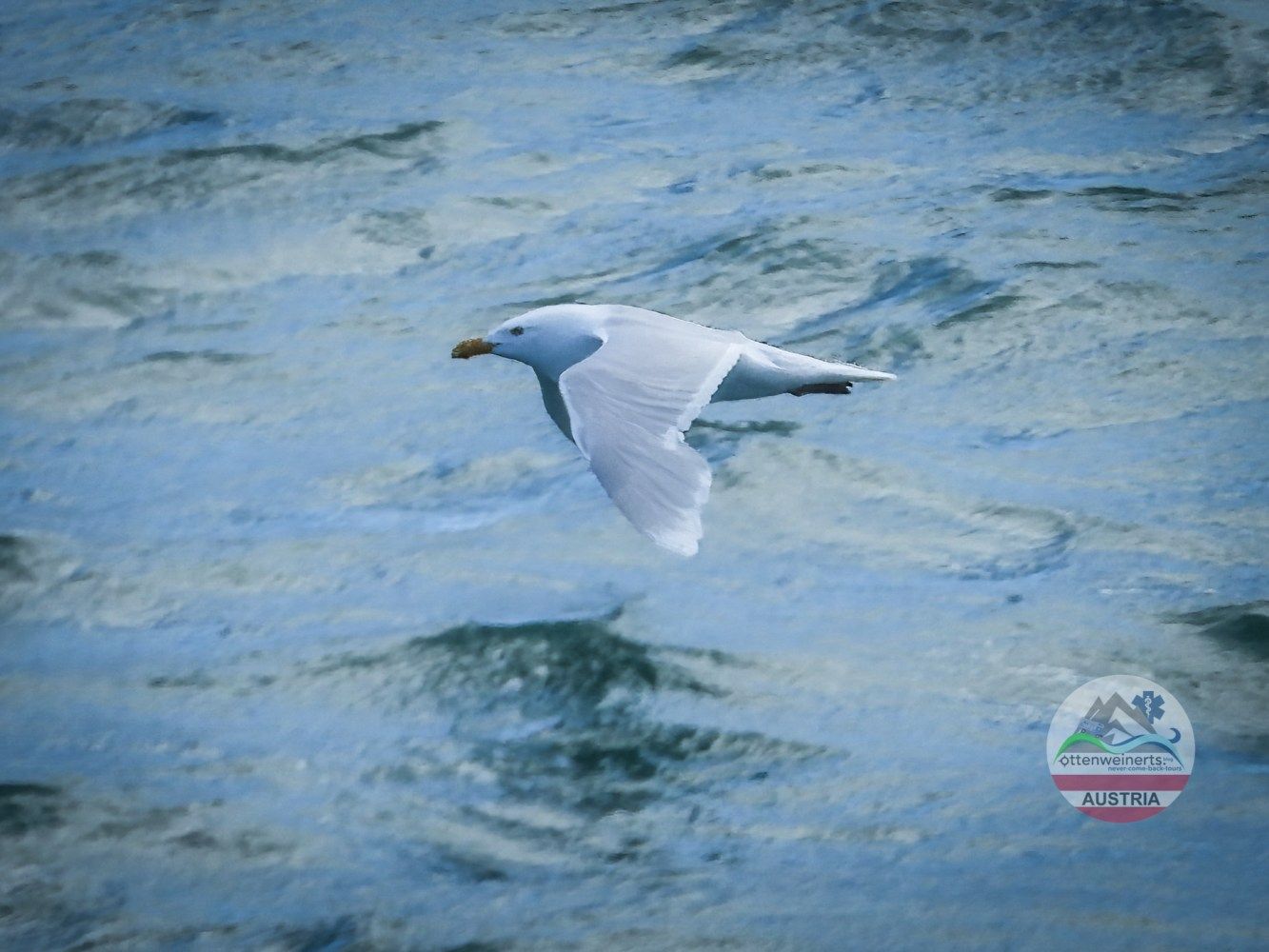
Eissturmvögel, Gryllteisten (Black Guillemots) und Eismöwen begleiten uns, sogar zwei Papageitaucher (Atlantic Puffins) fliegen über uns hinweg. Eisbären sehen wir heute leider keine, aber dafür ein Walross und mehrere Grönlandwale (Bowhead whales), und das ist eine kleine Sensation. Die Tiere wurden am Höhepunkt der Walfängerei beinahe ausgerottet, der heutige Bestand zwischen Grönland und Svalbard wird auf etwa 300 Tiere geschätzt. Sichtungen sind daher extrem selten, also haben wir Glück gehabt.

Während der Captain und ein Teil der Expeditionscrew auf der Brücke mit Ferngläsern Ausschau halten, hören wir uns Hazels Vortrag über Eisbären an – Verbreitungsgebiet, Populationen, Anatomie, Fortpflanzung – ganz besonders interessant finden wir, dass es – sehr selten, meist in Gefangenschaft – Kreuzungen zwischen Eisbären und Grizzlybären gibt, sogenannte „Grolars“ oder „Pizzlies“.

Marcos nachmittäglichen Vortrag über Entwicklung und Dynamik von Eis verschlafen wir dummerweise, aber dafür sind wir dann bei Williams mitreißender Präsentation über den norwegischen Nationalhelden Fritjof Nansen dabei, über den wir ja in Oslo schon viel gelernt haben. Anschließend berichtet Kaitlyn noch mehr Wissenswertes über Grönlandwale.

Kurz nach dem Abendessen, wir sind bereits nach Süden unterwegs mit Kurs auf die Hinlopenstraße, wird die See etwas ungemütlich und die sonst immer offene Brücke ist geschlossen. Die Antiemetika-Party startet, und die ersten Passagiere verlangen nach der Schiffsärztin (nein, das bin gottseidank nicht ich). Wir dagegen hören uns den spannenden Vortrag von Jens an, über Umberto Nobile und seine Luftschiff-Expeditionen zum Nordpol und die Rettungsmissionen nach der zweiten, missglückten Fahrt mit der „Italia“.

Inzwischen ist der Nebel sehr dicht, die Wellen noch höher und das Schiff rollt vor sich hin. Hoffentlich sind die Bedingungen morgen früh besser – sonst wird das mit dem geplanten Zodiacausflug zum Alkefjellet, dem Vogelfelsen, nichts werden.

Sunday, July 7th – in the pack ice

We spend the whole day in the drifting pack ice, move ice floes out of the way, making it to 80° 55´north, the northernmost point of our expedition – and we celebrate in style, with hot chocolate with whipped cream, outside on deck of course. While talking to Captain Artur we find out that he knows Oleg, the captain of the Ocean Victory (Antarctic adventure last year) very well – we take selfies and ask Captain Artur to relay our greetings.

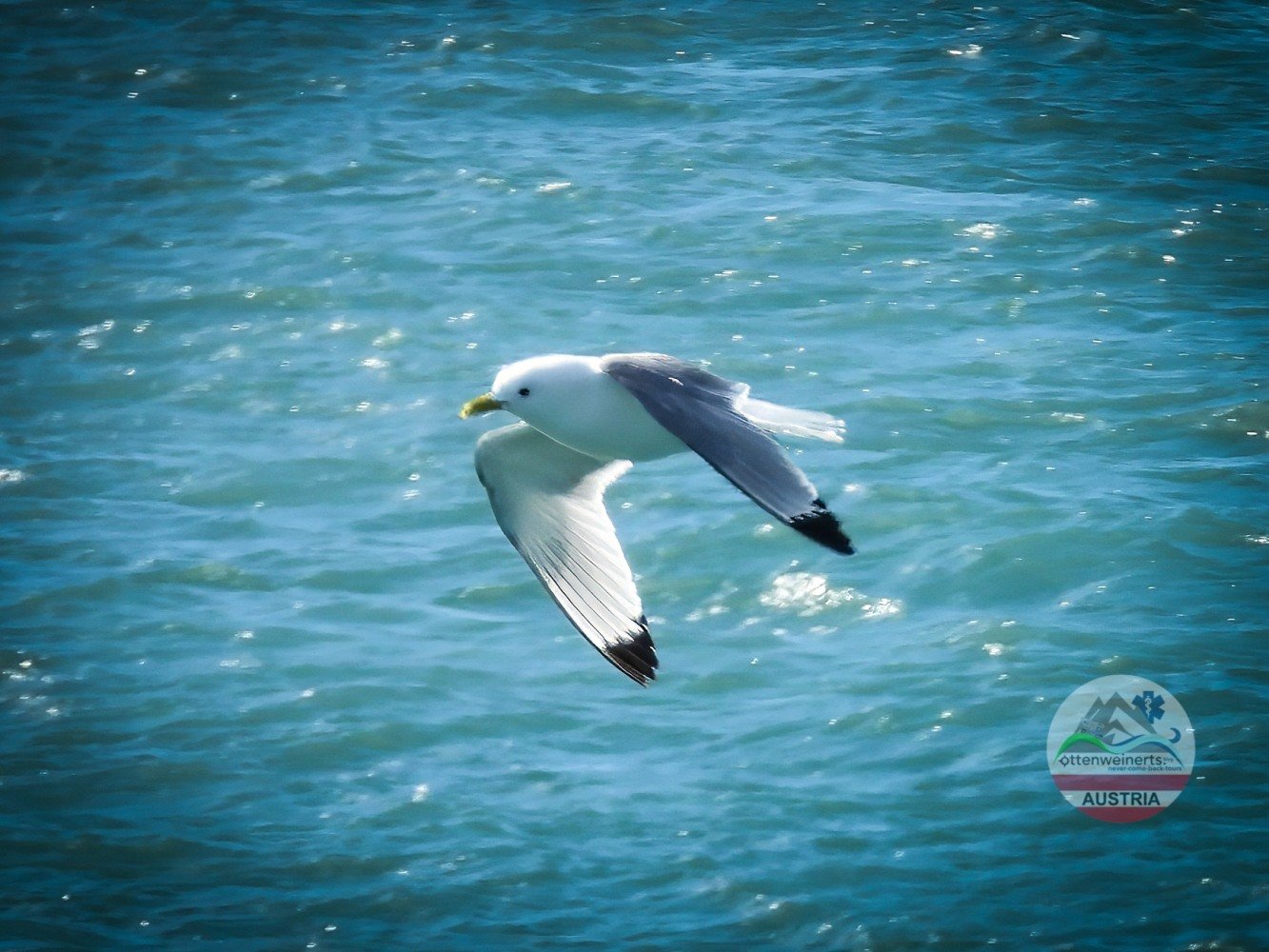
Northern Fulmars, black Guillemots and black-legged kittiwakes are accompanying us, even two Atlantic puffins fly over the ship. We don´t get to see any polar bears today, but a very picturesque walrus and several bowhead whales. And this is a sensation because these magnificent animals got almost extinct by whaler; the actual population between Greenland and Svalbard is estimated maximum of 300 animals. Therefore, sightings are extremely rare, and we were very luck to see them.

While the captain and part of the crew are on the bridge, trying to find more wildlife with their binoculars, we listen to Hazel´s lecture about polar bears – distribution area, population, anatomy, reproduction. One very interesting aspect are the very rare “grolars” or “pizzlies”, the offspring of polar bears and grizzly bears.

After lunch, we fall asleep in our cabin, therefore missing Marco´s lecture about development and dynamics of sea ice, but we wake up in time for Williams´ exciting presentation about the Norwegian national hero Fritjof Nansen and Kaitlyns´ lecture about bowhead whales.

Soon after dinner, already on our way south towards Hinlopen Strait, the sea gets a bit unpleasant, the usually open bridge is closed. The antiemetic party has started, passengers start asking for the ships´ doctor (and no, this time it´s not me, fortunately). We are feeling ok and we listen to Jens´ presentation about Umberto Nobile, his airship expedition to the North Pole and the rescue missions after the second, ill-fated attempt with the “Italia”. Meanwhile, the fog got very dense, the swell has increased and the ship is rolling from one side to the other. We hope that conditions will be better tomorrow, otherwise the zodiac outing to Alkefjellet, the bird cliffs, won´t be possible.

240706 – Tag des Walrosses / Day of the walrus #oceanwideexpeditions >

Über Nacht sind wir zu den 7 Inseln gefahren, der nördlichsten europäischen Landmasse, die noch mit „normalen“ Mitteln erreichbar ist, nur mehr 1024,3 km vom Nordpol entfernt. Vormittags kreuzen wir zuerst mit den Zodiacs vor Phippsøya, benannt nach Constantine John Phipps, der 1773 vergeblich versuchte, von hier aus den Nordpol zu erreichen. Er hatte übrigens einen 14jährigen Landsmann an Bord, den späteren Admiral Lord Nelson; eine der 7 Inseln heißt daher Nelsonøya. Einer der Guides fischt ein Stückchen Treibeis aus dem Wasser, in dem arktischer Krill zu sehen ist, sogar ohne Lupe.

Für die Walrossherde am Strand von Phippsøya brauchen wir weder Lupe noch Fernglas, denn wir können sie schon hören und riechen, bevor wir sie sehen, und Dickschnabellummen (Brunich‘s Guillemots) und Trottellummen (Common Guillemots) begleiten uns. Dann gehen wir an Land, spazieren über den Strand, vorbei an dem Walfischwirbel vor der alten Hütte und sammeln ein paar Plastikteile ein, die sich hierher verirrt haben.

Nachmittags kreuzen wir bei strahlendem Sonnenschein und blauem Himmel vor Parryøya, benannt nach William Edward Parry, der 1827 einen – ebenfalls missglückten – Versuch machte, mit Rentieren und Schlittenbooten den Pol zu erreichen. Und hier glühen die Kameras – auf einem warmen Felsen räkeln sich Dutzende Walrosse in der Sonne, etliche Kälber sind auch dabei, und ein paar der neugierigen Tiere schwimmen immer wieder in unsere Richtung. An den Steilklippen brüten Dreizehenmöven (Kittiwakes), im Schnee darunter sind – nicht mehr frische – Fuchs- und Eisbärspuren zu sehen.

Abends präsentiert Marcel den Plan für morgen, wir fahren noch weiter nach Norden, ins Packeis, in der Hoffnung, dort dann Eisbären zu sichten. Anschließend erzählt uns Hazel viel Wissenswertes über Walrosse und Julian spricht über „die alten Steine von Svalbard“, die Gesteinsarten und Formationen.

Saturday, July 6th – Day of the walrus

In the morning, we wake up near the 7 Islands, the northernmost European landmass reachable by normal means, only 636,47 miles away from the North Pole. We take a zodiac cruise near Phippsøya, named after Constantine John Phipps, who unsuccessfully tried 1773 to reach the North Pole from here. He had a 14-year-old fellow Englishman with him, the future admiral Lord Nelson – one of the 7 islands is named Nelsonøya. One of our guides fishes a piece of drift ice out of the water to show us the embedded krill, visible even without a magnifying glass.

And there is also no need for magnifying glass or binoculars to spot the group of walruses at the shore of Phippsøya – we can hear and smell them before they come into sight. A lot of sea birds – Brunich‘s Guillemots and Common Guillemots are accompanying us, we take our zodiacs to the shore, walk along the beach near the old whale bones and collect some plastic garbage.

In the afternoon – perfect sunshine and blue skies – we cruise near Parryøya, named after William Edward Parry, who made another failed attempt to reach the North Pole in 1827, with reindeer and sledge-boats. And here, our cameras are in danger of overheating – on a nice, sunny, rocky beach, there are dozens of walruses including many calves, enjoying the sun, and a few very inquisitive animals are ogling us, obviously as curios about us as we are of them. On the cliffs above, kittiwakes are nesting, in the snow at the foot of the cliffs we can see tracks of arctic fox and polar bears.

In the evening, at the daily recap, Marcel presents the plans for tomorrow – we will go further north, into the pack ice, hoping to see polar bears there. Afterwards, marine mammal expert Hazel talks about walruses and geologist Julian talks about the “old rocks of Svalbard”, rock morphology and formations.

240705 – Kein Eisbär in Texas / No polar bear in Texas #oceanwideexpeditions >

Um 6:45 weckt uns die liebliche Stimme von Marcel, unserem Expeditionsleiter, mit der Meldung „Eisbär voraus“. Schlaftrunken schlüpfen wir in ein paar warme Kleidungsschichten, schnappen die Kameras, begeben uns ans Vorderdeck und halten Ausschau. Einer der Guides hat ein Beweisfoto auf seiner Kamera und zeigt uns, wo der Eisbär sein soll. Ich sehe tatsächlich einen leicht gelblichen Fleck im weißen Schnee weit voraus am Ufer und drücke voller Begeisterung immer wieder auf den Auslöser. Nachher bewundern wir viele Fotos von dem hübschen Felsen im Schnee ….. der Bär war längst auf und davon.

Nach dem Frühstück geht es mit den Zodiacs an Land, zur „Texas Bar“, einer Trapperhütte von 1927 – hat nichts mit Texas zu tun und ist auch keine Bar – die Erbauer haben sich einfach einen Spaß erlaubt. Aber auf den Regalen stehen immerhin noch etliche Alkoholflaschen, gefüllt natürlich! Von dort machen wir einen Rundgang, wo wir unter anderem nördliche Alpennelken sehen und unseren ersten Sterntaucher – sehr entspannt, weil gut getarnt, nur am roten Fleck am Hals erkennbar. Die Skuas (große Raubmöwen) dagegen sind äußerst verärgert und fliegen heftige Attacken auf eine Touristengruppe – wahrscheinlich zu nahe am Nest vorbeigekommen.

Dann gibt es die Möglichkeit für einen „polar plunge“, der hier allerdings ein „polar swim“ ist, das heißt am Ufer ausziehen, ins Wasser waten und schwimmen – und das kostet deutlich mehr Überwindung als der Sprung direkt vom Schiff in die eisigen antarktischen Fluten voriges Jahr. Egal, wir sind hier, es ist die wahrscheinlich einzige Chance in meinem Leben, nördlich vom Polarkreis schwimmen zu gehen, also ab ins Wasser. War gar nicht so schlimm, meine Zehen sind bloß ein wenig taub für den Rest des Tages. Sigi hat eine gute Ausrede – er ist für die Dokumentation zuständig.

Nach dem Mittagessen folgt eine Zodiactour zum Monacobreen, dem Monaco-Gletscher, benannt nach Prinz bzw. Fürst Albert von Monaco, der Ende des 19. / Anfang des 20. Jhds mehrere Spitzbergen-Expeditionen finanzierte und auch selbst teilnahm. Wir haben wieder Glück mit dem Wetter, erst gegen Ende der Tour beginnt es leicht zu regnen, aber da sind wir schon fast zurück bei unserem Schiff. Nach der abendlichen Zusammenfassung des Tages hören wir von Marco Basics der Glaziologie, und dann ist wieder Ornithologe Simon dran, diesmal erzählt er uns einiges über Skuas, die großen Raubmöwen.

Nach dem Abendessen überqueren wir den 80. Breitengrad bei Moffen Island, wo sich mehrere kleine Herden Walrosse am Strand ausruhen – haben wir auch noch nie in freier Wildbahn gesehen – das entschädigt uns für den „Eisbärfelsen“ von heute früh.

Friday, July 5th – No polar bear in Texas

At 6:45 a.m., our expedition leader Marcel´s lovely voice gets us to jump out of our beds – a polar bear is in sight. Half asleep, we put some warm clothes on, pick up the cameras and make our way to the deck. One of the guides has proof – a photo on his camera, and he points in the direction where the bear is supposed to be. I actually spot a yellowish spot in the white snow, and I hit the button on the canmera many times. Afterwards we admire the many, many pictures of …. the pretty yellowish rock in the snow – the polar bear was long gone.

After breakfast, we take the zodiacs for a landing at “Texas Bar”, a trapper hut from 1927. There is no connection with Texas whatsoever, and it´s also not a bar – the builders of the hut were just having fun. But there are some alcohol bottles on the shelves inside the hut, most of them still containing liquids. We take a walk, get to see purple saxifrages and a red-throated diver – very relaxed because he is very well camouflaged, only the red coloration on his throat is visible. The skuas on the other hand are very annoyed, flying attacks on one of our groups – maybe they got too close to their nest.

Then we have the opportunity for a polar plunge, which turns out to be a polar swim rather than a plunge – we have to undress at shore, walk into the water until it´s deep enough and then swim – and that is much harder than the plunge directly from the zodiac into the icy waters of Antarctica last year. Doesn´t matter, it´s probably my one and only chance to go swimming so close to the North Pole, so off with clothes and into the water. Wasn´t so bad, by the way, just my toes are feeling a bit numb for the rest of the day. Sigi has a good excuse – he is responsible for documenting the whole endeavor.

After lunch, we go on a zodiac cruise towards the Monaco glacier, named after Prince Albert of Monaco who financed and also accompanied several expeditions to Spitzbergen around the turn of the last century. We are in luck with the weather again, it starts raining at the end of our tour when we are almost back at the ship. After today´s recap, Marco from Italy presents a lecture about the basics of glaciology, and ornithologist Simon talks about Skuas, the huge predatory gulls.

After dinner, we cross 80° latitude near Moffen island, where several groups of walruses are napping at the shore – we have never seen walruses in their natural habitat, that sort of compensates this mornings´ “polar bear rock”.

240704 – in der nördlichsten Siedlung der Welt / the world´s northernmost community #oceanwideexpeditions >

Über Nacht haben wir die Strecke bis in den Krossfjord an Spitzbergens Westküste zurückgelegt. Heute morgen gibt es zuerst Frühstück mit Aussicht auf den Lilliehookbreen (Gletscher) bei strahlendem Sonnenschein, und dann noch weitere verpflichtende Briefings: Richtiges Verhalten im Zodiac (nicht aufstehen ohne den Fahrer zu fragen), Regeln für den Landgang (nichts hinterlassen, nichts mitnehmen) und was tun bei Eisbär-Sichtungen (nicht anlocken, nicht streicheln). Vor dem Mittagessen bekommen wir unsere Leih-Gummistiefeln ausgefolgt, die wir dann am frühen Nachmittag im Kingsfjord das erste Mal benötigen.

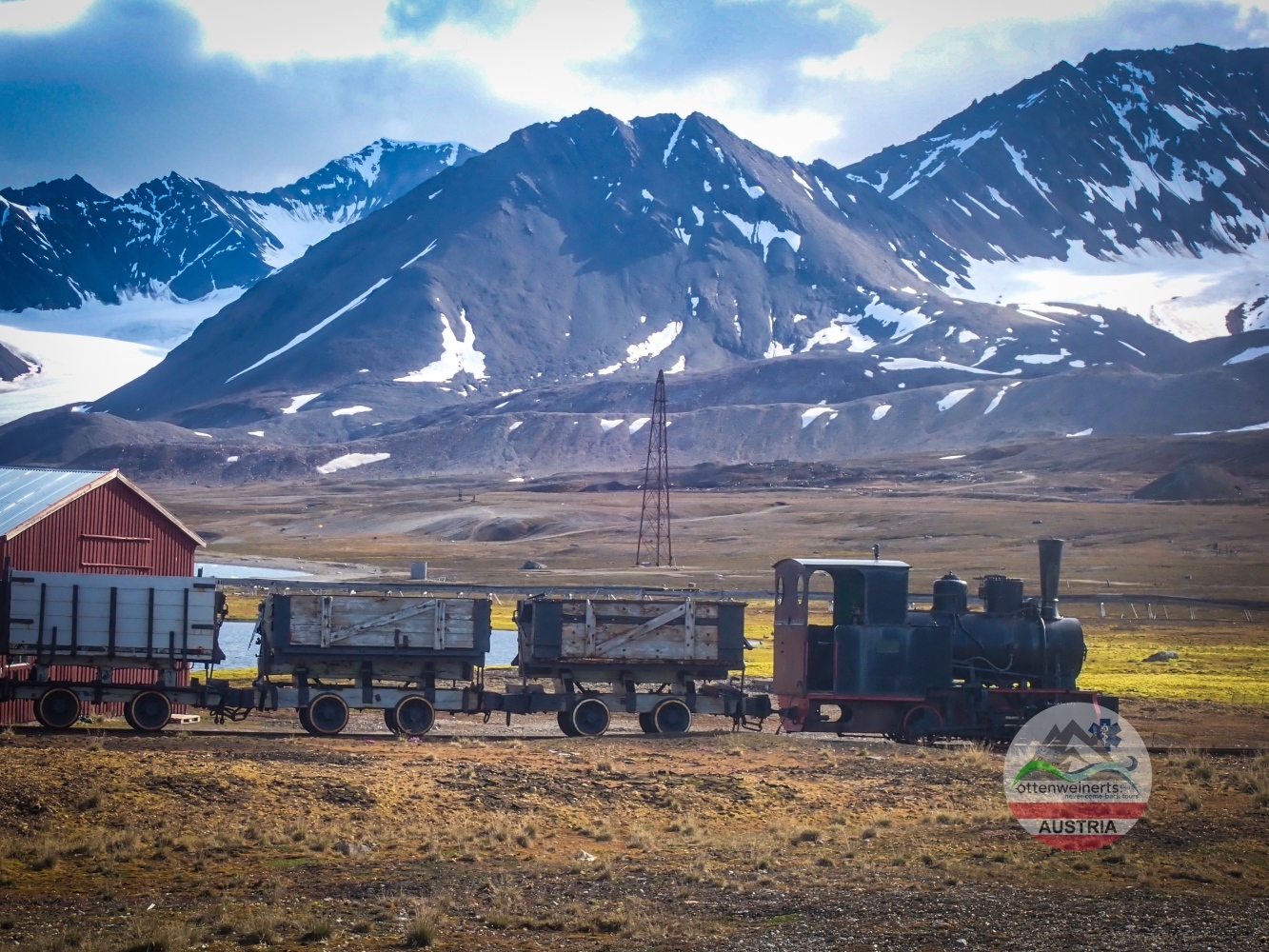
Mit den Zodiacs landen wir in Ny-Ålesund, die nördlichste Siedlung der Welt, einst als Bergbausiedlung gegründet; die alte Lokomotive für den Kohletransport steht noch hier. Ein schweres Grubenunglück bedeutete 1963 das Ende des – ohnehin nicht sehr rentablen – Kohlebergbaus. Heute arbeitet hier eine internationale Wissenschaftergemeinschaft an Forschungsgebieten im Bereich Klima und Umwelt, Atmosphäre, marines Leben und Ozeanographie. Für unsere chinesischen Mitreisenden ist ein Selfie vor der chinesischen „Yellow River Research Station“ natürlich ein Muss.

Wir wandern durch die kleine Ortschaft mit knapp unter 200 Bewohnern (zumindest jetzt, im Polarsommer), schauen in das alte Postamt (leider gibt’s den alten Poststempel nicht mehr, weil Touristen ihre Reisepässe damit gestempelt haben – hätten wir natürlich nie getan, niemals, wir doch nicht…….), und kaufen ein paar Souvenirs im nördlichsten Shop der Welt, wo man schon weit vorausplant: auf den T-Shirts steht Ny-Alesund, 79° nördliche Breite – das wird aufgrund der Plattentektonik in ein paar Jahrmillionen auch zutreffen. Jetzt ist die korrekte Verortung 78°55´, und damit etwa 9 km vom 79. Breitengrad entfernt.

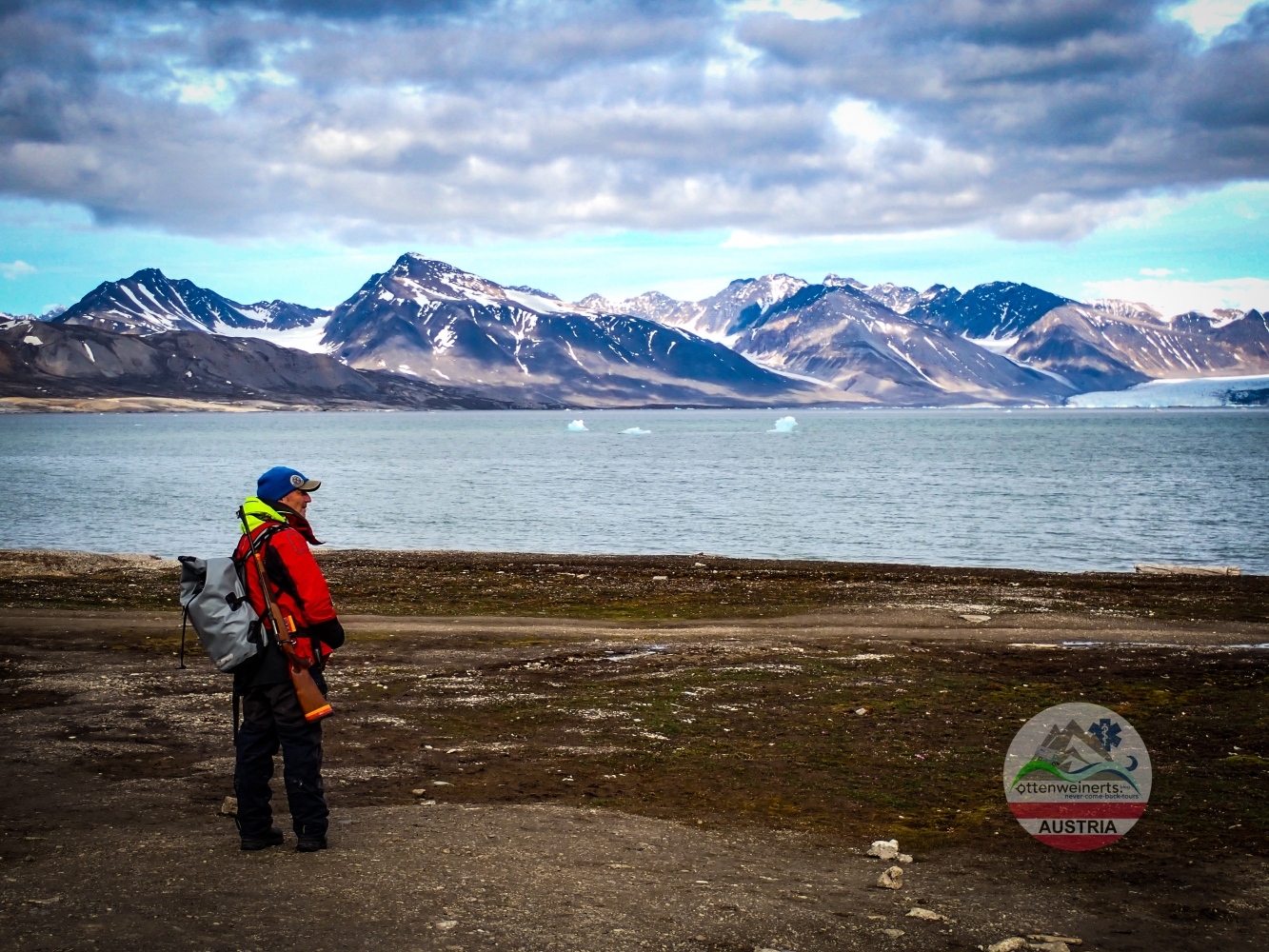
Bei der Büste von Roald Amundsen sammelt sich die Gruppe, um dann geschlossen zum Amundsen-Mast zu marschieren, an dem die Luftschiffe „Norge“ und „Italia“ für die Nordpolexpeditionen 1926 und 1928 vor ihrem Start verankert waren. Der Mast liegt außerhalb der sicheren Zone, daher sind unsere Guides mit Gewehren bewaffnet, für den Fall eines unvorhergesehenen Eisbär-Kontakts. Und im Hintergrund grasen friedlich ein paar Rentiere – übrigens: Rentierbullen tragen ihr Geweih im Sommer, im Herbst werfen sie es ab. Rentierkühe dagegen sind im Winter mit Geweih bewaffnet – also die Rentiere, die Santas Schlitten ziehen, sind lauter Damen!!

Am Rückweg, immer auf den gekennzeichneten Wegen, um die empfindliche Tundra-Flora nicht zu zertrampeln und um brütende Vögel nicht zu stören, erfahren wir im Museum noch mehr Details über die von hier gestarteten Expeditionen sowie über das Leben in diesem abgeschiedenen Ort. Und in der Nähe der Hundebehausungen sehen wir Wissenschafter bei der Arbeit – eine Küstenseeschwalbe wird eingefangen, vermessen, gewogen und beringt – der Rest ihrer Familie ist ziemlich empört und fliegt laut schimpfend Angriffe auf die Forscherin.

Nach der allabendlichen Zusammenfassung der Ereignisse des Tages mit Blick auf den Plan für morgen hören wir noch zwei Kurzvorträge: William aus Frankreich berichtet über Salomon August Andree, der 1897 beim Versuch, mit seinem Ballon zum Nordpol zu fahren, umkam; und von Simon aus Schottland erfahren wir Wissenswertes über Arctic Terns, also Küstenseeschwalben – genau die verteidigungsfreudigen Vögel, die wir nachmittags beobachten konnten.

THURSDAY, July 4th – the world´s northernmost community

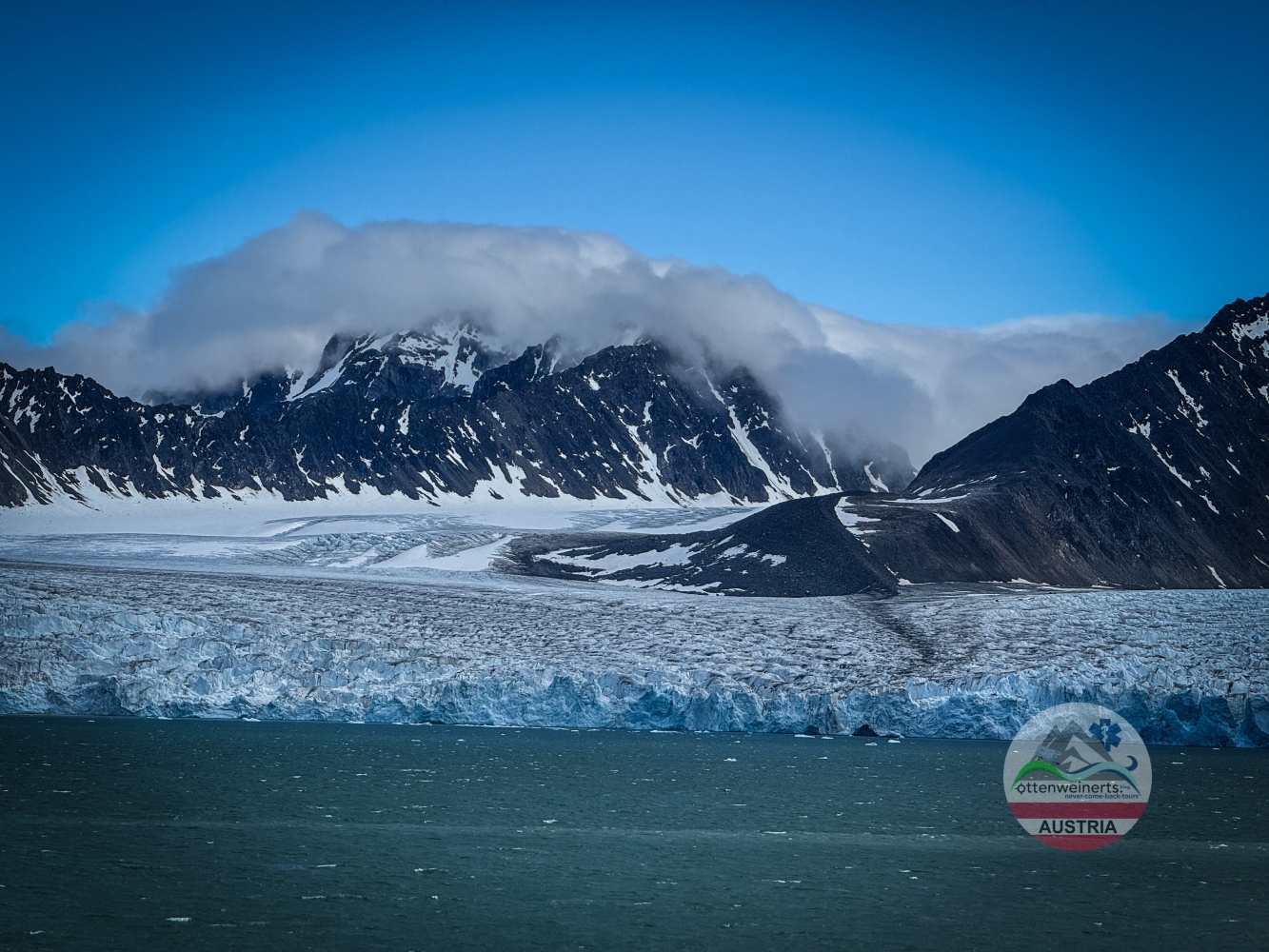
In the night, we reached the Krossfjord at Spitzbergen´s west coast – we are having breakfast in front of the magnificent Lilliehook Breen (Glacier), and then there are some more mandatory briefings: how to behave in a zodiac (don´t get up without asking the driver), landing rules (don´t leaving anything, don´t take anything) and polar bear rules (don´t lure them, don´t try to cuddle). After that, it´s boots party – we get our borrowed rubber boots which we will need for the first time in the afternoon in Kingsfjord.

The zodiacs transport us to Ny-Ålesund, the world´s northermost community and another former coal mining town; the old locomotive and some lorries are still visible. A tragic mining accident in 1963 meant the end of the – anyway not very profitable – coal mine. Today, Ny-Ålesund is an international research station where experts from all over the world live and research in the fields of climate and environment, atmosphere, marine life and oceanography. And all of the Chinese guests on board our ship had to take selfies in front of the Chinese “Yellow River” research station.

We stroll through the small village with almost 200 inhabitants (at least now, during the summer), look into the old post office (unfortunately the old postmark is gone because tourists stamped their passports with it – we would never have done that, never ever, of course not ….), and we buy some souvenirs in the northernmost souvenir shop which is fit for the future: the T-Shirts read “Ny-Ålesund, 79° North” – which will be true in a few million years because of the plate tectonics. Now, the correct geographic position is 78°55´ and therefore about 5,6 miles south of latitude 79° north.

Then, we gather at the bust of Roald Amundsen and walk as a group to the Amundsen mast, where the airships “Norge” and “Italia” were moored before their start towards the North Pole in 1926 and 1928 respectively. The mast is located outside the safe perimeter, so our guides are carrying rifles in case of an unexpected meeting with a polar bear. But we see only some reindeer grazing in the background; by the way: male reindeer have their antlers in summer and loose them in autumn. Female reindeer on the other hand, get theirs in autumn and carry them all winter. Therefore, the reindeer pulling Santa´s sleigh – they are all girls!!!

On the way back, always on the marked paths in order not to trample the delicate vegetation or disturb nesting birds, we visit the local museum to learn more about the expeditions which started from here and about life in this secluded place. Near the dog kennel, we see researchers at work – a captured artic tern gets measured, weighed and a ring is put on its leg. The rest of the tern family is rather annoyed, flying heavy attacks on the researcher.

In the evening, after today´s recap, we hear two very interesting lectures: William from France tells us the story of Salomon August Andre, who died trying to reach the North Pole with his balloon in 1897; and Simon from Scotland informs us about Arctic terns – exactly the defensive birds we could watch in action this afternoon.

240703 – Unter Tage und aufs Wasser / Into the mountain and onto the water #oceanwideexpeditions >

Wir starten heute unter Tage, im Dunklen – mit der Besichtigung der „Gruve 3“, einer von insgesamt sieben hier existierenden Kohlegruben. Die Kohlevorkommen hier waren die Ursache für die Gründung von Longyearbyen im Jahre 1906, und der Name stammt vom Gründer, dem Amerikaner John Munroe Longyear. Die Kohle hat einen Reinheitsgrad von 97%, allerdings verlaufen die Flöze horizontal und mussten manuell und im Liegen abgebaut werden. Wir durften in einen Stollen hineinkriechen, 78 cm hoch, und das ist bereits ein Luxusstollen – der niedrigste Stollen war nur 38 cm hoch – unvorstellbare Arbeitsbedingungen!

In der Grube 3 befindet sich auch das AWA, das Arctic World Archive, eine internationale Lagerstätte für Dokumente aller Art, die für künftige Generationen erhalten bleiben sollen. An einer weiteren Lagerstätte kommen wir bei der Rückfahrt von der Grube vorbei, dem „Global Seed Vault“. Hier werden Saatgutproben gelagert, vor allem von landwirtschaftlichen Nutzpflanzen, um im Falle einer weltweiten Katastrophe die Artenvielfalt zu erhalten.

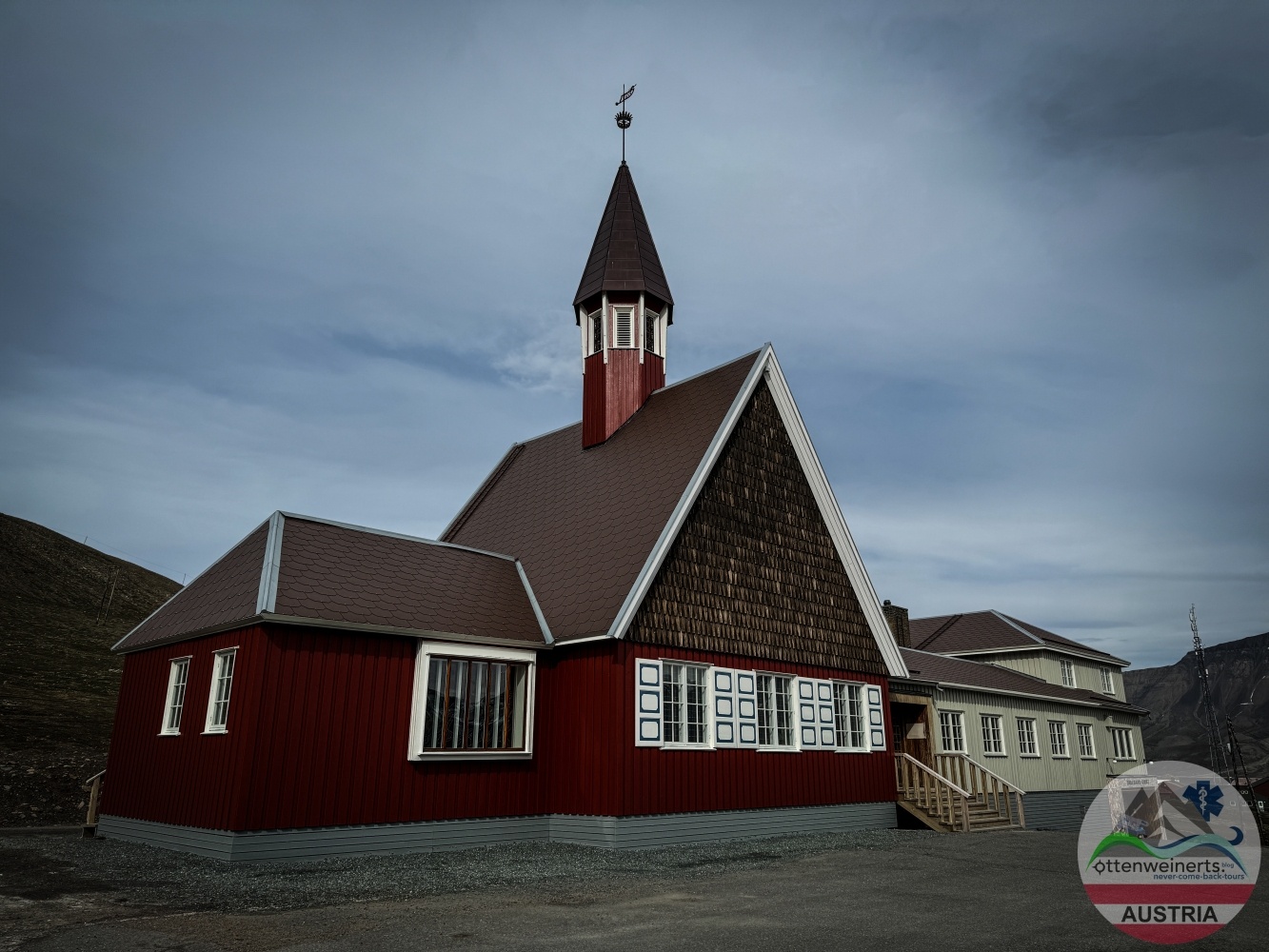
Unser freundlicher Busfahrer lässt uns dann direkt bei der Kirche von Svalbard aussteigen. Dies ist wohl eines der ungewöhnlichsten Gotteshäuser, das wir je besucht haben – für Besichtigungen offen 24/7, man muss die „Schühe“ ausziehen, und es gibt einen gemütlichen Versammlungsraum mit einem großen Kamin, und einen Tisch mit Kaffee und Keksen. Ein echtes Gemeindezentrum – das findet auch die Familie Kurzschnabelgänse mit ihrem flauschigen Nachwuchs, gleich hinter der Kirche.

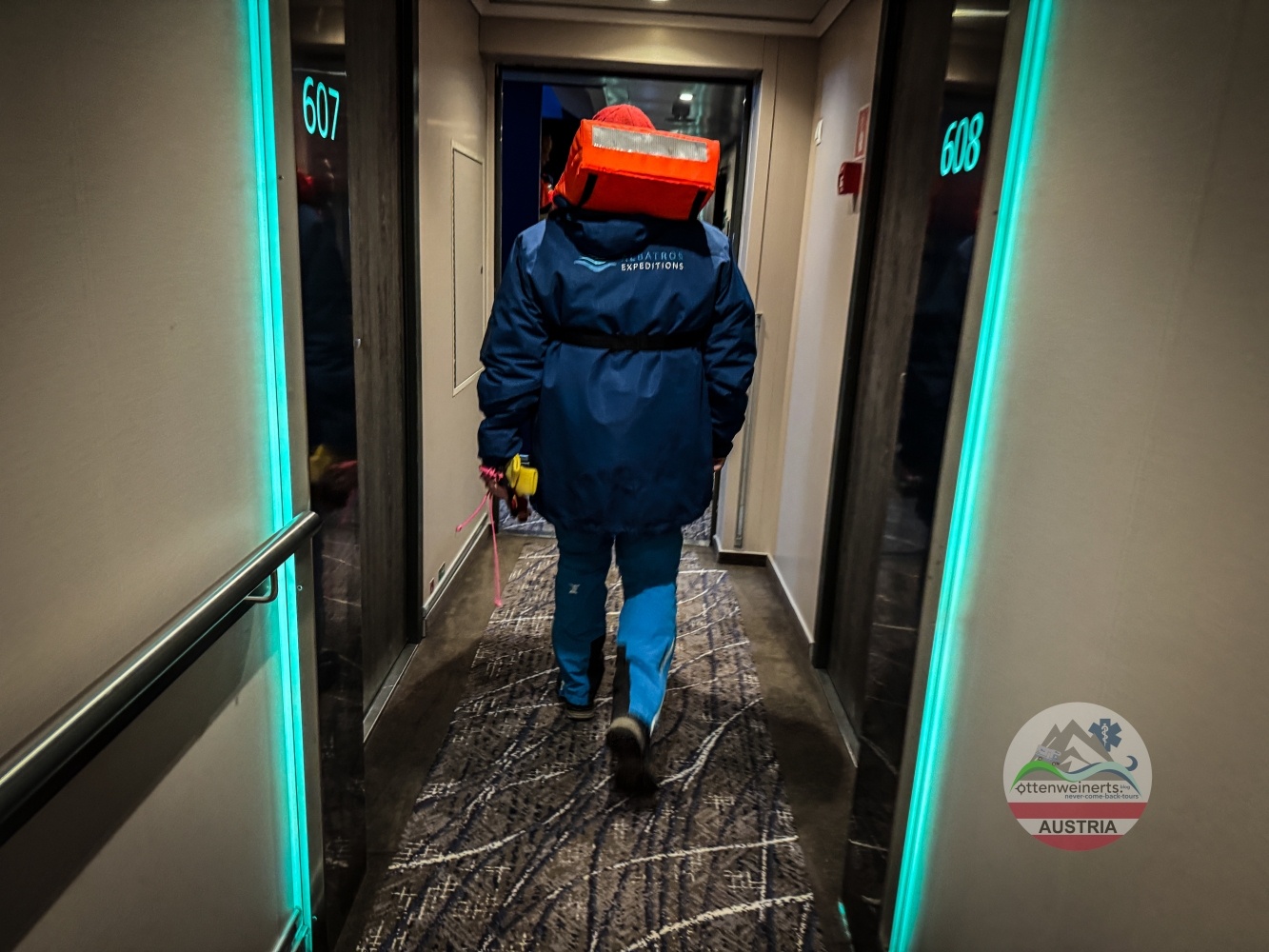
Dann ist es auch schon Zeit, um am Schiff einzuchecken. Wir beziehen unsere Kabine, anschließend geht es zum verpflichtenden Safety Briefing, mit „evacuation drill“ im vollen Outfit mit angelegten Schwimmwesten (SEHR unkomfortabel – aber wir werden sie ja nicht brauchen – hoffen wir). Beim anschließenden Willkommenscocktail-Empfang gibt uns Albert, der Hotelmanager, die ersten Informationen und stellt uns Kapitän Artur und das 23köpfige Expeditionsteam mit Teamleader Marcel vor – währenddessen legt unser Schiff völlig unbemerkt und ganz leise ab – wir sind am Weg zu unserem Abenteuer Arktis.

WEDNESDAY, July 3rd – Into the mountain and onto the water

We start our day by going underground into the darkness, visiting “Gruve 3”, von seven coal mines here around Longyearbyen. The local coal deposits were the reason why Longyearbyen was founded in 1096, and it was named for its founder, the American John Munroe Longyear. The coal here is 975 pure which is excellent, but the coal seams run horizontally, so the workers had to lay down and extract the ore manually. We could crawl into one of the tunnels, only 31 inch high, but that was luxury already – the lowest tunnels was only 15 inch in height – unimaginable working conditions.

Deep within the mine, there is also the AWA, the Arctic World Archive, an international deposit for documents of all kinds which shall remain here for generations to come. On the way back from “Gruve 3”, we pass another deposit, the “Global Seed Vault” where seed samples are stored, mainly from agricultural crops in order to maintain biodiversity in case of a global catastrophe.

Afterwards the friendly bus driver drops us right in front of the Svalbard church, and this is one of the most unusual Christian places of worship we have ever visited: open 24/7, you have to take of your shoes, and there is a cozy meeting room with a huge open fire place and a table with coffee and cookies – a real community center. And behind the church, we find a pair of pink-footed geese with their fluffy chicks.

Then, finally, it´s time to check in on our ship, the “Hondius”. We move into our very nice cabin, then we have to attend the mandatory safety briefing including evacuation drill with our life vests on (VERY uncomfortable, but we won´t be needing them, we hope). After that, at the welcome cocktail reception, Hotel manager Albert gives us some information about the life on the ship and introduces Captain Artur and the expedition team, consisting of 23 experts, led by Marcel. Meanwhile, our ship has left the harbor, very quietly and totally unnoticed – we are on our way to our Arctic Adventure.

240616 – alte Autos, wilde Tiere und noch ein Musical >

Sunday / Sonntag, June 16, 2024

Das Aufstehen fällt heute schwer, gestern ist es doch sehr spät geworden, aber es ist sonnig – wir erinnern uns an den Tipp mit der Modellbaubörse, und machen uns auf den Weg zum Freilichtmuseum Am Kiekeberg, etwa eine Stunde südlich von Hamburg. Und da staunen wir nicht schlecht – das Museum an sich ist schon sehr interessant und wir finden bei am Modellbauflohmarkt auch drei neue Stücke für unsere Sammlung, aber die echte Sensation sind die hier ausgestellten, liebevoll gepflegten und fahrtüchtigen Oldtimer. Der Publikumsandrang ist entsprechend groß, es herrscht Volksfeststimmung mit lokaltypischer Gastronomie, und in der Scheune spielt eine Band 50er Jahre Rock‘n Roll. 

Im Wildpark Schwarze Berge, gleich hinter dem Freilichtmuseum, ist genauso viel los – hier ist heute Mittelalterfest. Uns interessieren mehr die tierischen Bewohner dieses Parks, vor allem die Luchsmama mit ihren drei flauschigen Kleinen, gerade mal ein Monat alt, und die Elchkuh mit den beiden Jungen, auch einen Monat alt, aber größer als wir. Diesen Park muss man erwandern, es geht oft steil bergab und bergauf, aber es lohnt sich, so wie auch das Bezwingen der 287 Stufen auf den Elbblick-Turm. Die Aussicht ist phänomenal, man sieht bis zum Hafen mit der Elbphilharmonie und zum Zentrum mit St. Michaelis.

Nach über 6 Stunden in Freilichtmuseum und Wildpark tun uns die Beine weh, und wir machen uns auf den Rückweg Richtung Zentrum, aber es ist eigentlich noch zu früh, um ins Hotel zurück zu kehren. Kurz entschlossen buchen wir Restplatz-Tickets für den „König der Löwen“ und fahren direkt zu den Landungsbrücken am Elbufer. Wir versorgen uns noch schnell mit ein paar Fischbrötchen und Getränken, das Musical-Shuttle bringt uns ans andere Ufer der Elbe zum Theater, und auf der Kai-Mauer geniessen wir unser Abendessen und die Aussicht – man sieht von hier aus auch die Kunst-Installation anlässlich der Fußball-EM, drüben im Container Hafen.

Den kurzfristigen Entschluss, das Musical zu besuchen, haben wir nicht bereut – die Aufführung war fantastisch, die Musik ist ja ohnehin mitreissend, das Ensemble stimmgewaltig – besonders Rafiki hatte es uns angetan. Naja, der König der Löwen läuft ja immerhin schon das 24. Jahr hier in Hamburg, und die Vorstellung war beinahe ausverkauft. Also muss es ja wirklich gut sein.

old cars, wild animals and yet another musical

Getting up is hard today, we came back late yesterday, but it is nice and sunny – we remember the info about the Oldtimer Meeting and the model car swap meet, so we take train and bus to the open air museum at Kiekeberg, about an hour south of Hamburg. And again, this was a good idea – the museum itself is very nicely done, and at the swap meet we find three new additions for our ambulance collection, but the real sensation here are the vintage cars, all of them in top condition and looking their best. Therefore, the place is swarming with visitors, the atmosphere is festival-like, lots of food carts, and in the barn, a Rock-a-billie band makes our feet twitch.

Afterwards, we continue to the wildlife park „Black Mountains“ about 10 minutes away, and it’s very crowded here, too – a Medieval festival is taking place this weekend. We are more interested in the regular inhabitants of the park, especially in the mama lynx with her three fluffy cubs, just one month old, and mama moose with her two babies, also about a month old, but taller than we are. The park itself is beautiful, nestled into the hills with steep uphill and downhill paths, but it´s worth the effort. And the reward for climbing the 287 steps to the top of the lookout tower is a fantastic view over the area, including Hamburg’s harbor with the Elbphilharmony  and the city center including St. Michael to the north.

After more than 6 hours at the museum and the wildlife park, our feet hurt and we take bus and back to the city, but it’s still early and we don’t want to return to our hotel yet. So we search online and find some last minute tickets for yet another musical, Disney’s  „The Lion King“ – the train takes us directly to the jetties at the northern bank of Elbe river, we get some fish sandwiches and drinks and the musical ferry shuttles us to the south bank. Sitting on the quai wall, we enjoy dinner with a grand view over the river up to the container harbor, including the art installation erected there to celebrate the European Soccer Championship. 

The last minute decision to see „The Lion King“ was also a very good one – a fantastic performance by a great ensemble, especially Rafiki had an incredible voice. Well, the grand opening of this musical here in this stage took place almost 24 years ago and tonight’s show was almost sold out – so it’s got to be good.

240614 – Hagenbeck und Herkules >

Friday / Freitag, June 14, 2024

Die Wettervorhersage verspricht einen trockenen und halbwegs sonnigen Tag, also auf in den Zoo. Der Tierpark Hagenbeck wurde mit revolutionären Konzepten gegründet – keine Käfige, sondern Gräben hinter Sichtschutz und damit freie Sicht auf die Tiere, sowie keine strikte Artentrennung – Tiere aus dem gleichen Lebensraum teilen sich auch ein Habitat – bei der Eröffnung 1907 eine Sensation. Die ausgedehnte Eiswelt mit Walrossen, Pinguinen und Eisbärmama mit einem verspielten Jungen finden wir großartig, im fantastischen Tropenaquarium freuen wir uns besonders über die frei fliegenden Vögel und Flughunde. Auch hier lernen wir wieder Neues – von Onagern etwa (nein, kein Tippfehler) haben wir noch nie zuvor gehört – und sehen alte Bekannte, wie die Klippschliefer aus Namibia (unglaublich, aber wahr: kleine Cousins der Elefanten), Maras und Perlhühnchen laufen frei herum, und Alpakas und die putzigen, aber diebischen Nasenbären kennen wir auch schon aus Südamerika.

Plötzlich ist es 17 Uhr vorbei, wir haben mehr als 7 Stunden in Zoo und Aquarium verbracht. Wir fahren ein Stückchen mit der U-Bahn Richtung Süden, und spazieren dann gemütlich durch Altona zum Neue Flora Theater – wir probieren‘s nochmal mit Musical, heute sehen wir uns Herkules an – und das war eine gute Entscheidung. Dass die Musik zu diesem Disney-Klassiker mitreißend ist, wussten wir ja, aber hier passt auch die Umsetzung auf ein Bühnenstück und das Ensemble ist wirklich stimmgewaltig. Dieses Musical können wir wirklich empfehlen!

Hagenbeck & Hercules

The weather forecast promises a dry and more or less sunny day, so we decide to visit the zoo. The concept of “Hagenbeck’s Animal Park” was revolutionary – invisible moats instead of cages enable unblocked views of the animals, and species sharing the same habitat in the wild get to share the same enclosures here, too – a sensation when the zoo opened in 1907. We specially like the icy polar world with walruses, penguins and mama polar bear with her playful cub, and we enjoy the fantastic tropical aquarium with free flying tropical birds and flying foxes. Maras (South American desert hares) and guinea fowl roam free all over the place. There is a lot to learn here in the zoo, we have never heard of Onagers before (and no, that’s not a typo), and me meet old acquaintances, like rock hyraxes which we have observed in Namibia (hard to believe but these cute little fur bundles are related to elephants), and Alpacas and coatis, the cute but thieving little bears which live in South America.

All of a sudden it is past 5 pm, we have spent more than 7 hours in the zoo and the aquarium. We take the subway southbound, and walk through Altona to the New Flora Stage Theater – we decided to see another Musical. Tonight it’s Disney´s „Hercules“, and this was a good decision. We have seen the animated movie and we know that the music is really, really good, and in this case we also like the stage adaptation and the fantastic ensemble with very powerful voices. We can recommend Hercules for a nice evening out!

231230 – Nachlese: Puerto Madryn – Argentina – 2023.02.15

„Und da kommen sie auch schon – neugierige, verspielte junge Seelöwen, die uns umkreisen und mit ihren Glubschaugen eingehend betrachten. Sie drehen Pirouetten, nähern sich von vorne, hinten und oben, einer beißt mal probehalber in mein (rosa) Maskenband, aber das sitzt zu fest, um es zu stehlen.“ 


„And there they are – curious, playful adolescent sea lions, circling around us and checking us out with their googly eyes. They are dancing pirouettes, coming from the front, the back and above, one them even biting carefully into my pink mask band on the back of my head, but this is fixed too tightly to steal it.“

Originalbeitrag: https://ottenweinerts.blog/2023/02/17/230215-tauchen-mit-seeloewen/

230827 – Noch ein Sonntag in Buenos Aires >

Sonntag / Sunday, August 27, 2023
Tag 497 – Noch ein Sonntag in Buenos Aires

Es ist sonnig, halbwegs warm und Sonntag – wieder Flohmarkt in San Telmo. Wir bahnen uns einen Weg durch die Marktstände und die Besucher Richtung Rio Dique, wo die Fregatte Sarmiento auf Besucher wartet. Das ehemalige Schulschiff lief 1899 auf ihre Jungfernfahrt aus und absolvierte bis 1939 insgesamt 39 Ausbildungsreisen in alle Welt, dann war es bis 1960 in argentinischen Gewässern unterwegs. 1961 wurde es in ein Museumsschiff umgewandelt; leider sind derzeit Teile wie etwa die Kapitänskajüte wegen Renovierung nicht zugänglich.

Nach dem Besuch am Schiff geht es zurück Richtung Flohmarkt. Wir kommen an der Casa minimal vorbei, dem schmalsten Haus von Buenos Aires, erbaut Anfang 19. Jhd. Ein Stückchen weiter, am Flohmarkt, kaufen wir dann doch das Buch, das wir letzte Woche gesehen haben – ein Fachbuch über argentinisches Blechspielzeug von 1900 bis 1970, im Handel vergriffen, auch online nicht erhältlich, kleine Auflage, dementsprechend teuer. Aber wir wissen, dass wir dieses Buch wahrscheinlich nie wieder finden werden. Also heute Geld ausgeben oder ab morgen ärgern. Zwei schöne Blechschilder und eine Holzambulanz laufen uns auch noch zu.

Wir bringen die Beute in unser Apartment, machen Mittagspause und überlegen dann, was wir uns noch anschauen wollen. Es gäbe in der Nähe noch Museen, aber das Wetter ist zu schön. Also steigen wir in den Bus und fahren zum Eco-Parque, dem zoologischen Garten. Eigentlich Ex-zoologischen Garten – die meisten Gehege sind leer und viele Gehwege sind abgesperrt, aber Pfaue, Enten und Gänse, Maras (Pampashasen) und sogar Bisamratten laufen uns vor die Füße. Wir können uns das nicht erklären und fragen eine der netten Parkwärterinnen. Es stellt sich heraus, dass sich der Zoo umorientiert und auf Schutz, Zucht und Auswilderung gefährdeter autochthoner Arten ausrichtet. Daher sind viele Tiere bereits in Schutzgebiete in Argentinien und im Ausland übersiedelt. Die Elefanten reisen demnächst in ein Reservat in Mato Grosso, Brasilien, auch die Tapire bekommen ein neues Zuhause. Die Riesenotter dagegen sollen hier Nachwuchs produzieren, der dann in die Ibera-Sümpfe ausgewildert werden soll. Die Giraffen und das Kamel dagegen dürfen für den Rest ihres Lebens hier bleiben. Der Park wird umgestaltet, Pfaue, Enten, Gänse und Fische dürfen bleiben, und die Maras sowieso – die kümmern sich um die Rasenpflege.
Wir machen uns auf den Heimweg, und versuchen ein letztes Mal unser Glück bei der Iglesia y Convento de San Francisco und der Capilla San Roque, die bis jetzt immer geschlossen hatten. Heute Abend hat zumindest die Kapelle offen, Messe wird gelesen, aber die wunderschöne Franziskanerkirche ist nach wie vor zu – durch das große Glasportal sehen wir eingepackte Heiligenstatuen – also wegen Renovierung geschlossen.

Nach dem Abendessen ziehen wir nochmals los. Wir haben die ganze Woche im Internet nach Tango-Shows gesucht, haben auch viele gefunden, konnten uns aber zu nichts entschließen. Gestern abend sehen wir zufällig das La Ventana, nur einen Block von unserem Apartment entfernt und können online „Show only“ buchen, also ohne Abendessen und Transfer. Und diese Show ist wirklich exzellent – die Musiker fantastisch, die beiden Sänger ausgezeichnet, und die drei Tangopaare wirbeln ihre Beine in schwindelerregendem Tempo herum. Das Publikum ist international, von Brasilien und Uruguay über USA bis Italien und sogar Österreich  dementsprechend ist das Programm gestaltet. Als „Evita“ auf der Bühne auftaucht und „Don´t cry for me, Argentina“ singt, bleibt kein Auge trocken. Der schönste Teil für uns aber war die Folklore-Gruppe – zu Klängen von Panflöte und Gitarre ziehen auf der Riesenleinwand im Hintergrund argentinische Impressionen vorbei – genau das, was wir in unseren insgesamt 4 Monaten Reise durch dieses großartige Land gesehen haben – Anden und Atlantik, Kakteenwüste und Dörfer mit geduckten, weißen Adobe-Häuschen, Pampa und weiter Horizont mit Kondoren. Da kommen auch uns ein paar Abschiedstränen – übermorgen geht es schon nach Hause.

Day 497 – Another Sunday in Buenos Aires

It is sunny, acceptably warm, and Sunday – flea market again in San Telmo. We make our way through the market stalls and the visitors towards Rio Dique, where the frigate Sarmiento is waiting for visitors. The former school ship began her career in 1899, traveling 39 times all over the world until 1939; then she served as school ship in Argentinian waters until 1960. In 1961, she was turned into a museum; unfortunately, some parts like the captain´s quarters are closed for renovation right now.

Then, we return to the flea market, passing by Casa Minima, the smallest house of Buenos Aires, built at the beginning of the 19th century. At the flea market, we find ourselves standing at the book stall where we saw a very special book last week – a book about Argentinian tin plate toys from 1900 to 1970, limited edition, no available in the book stores anymore, and not available online, either. And we know that we probably will never find that book ever again. So, it´s “spend money today or cry tomorrow”. We also find a nice handmade wooden ambulance and two tin plate signs.
We carry our booty back to our apartment; after lunch break, we need to decide what to do. There are several museums around, but the weather is too nice to be inside, so we take the bus to the Eco-Parque, the zoological garden. Well, the former zoological garden – most of the enclosures are empty, many walkways are cordoned off, but peacocks, ducks and geese, maras (pampas hares) and even muskrats cross our way. We are puzzled and ask one of the nice park guards. She explains to us that the zoo has changed its goals and projects, concentrating on protection, breeding and releasing endangered autochthon Argentinian fauna. Therefore, many animals have been relocated to reservations in Argentina and also other countries. The elephants will find move to an animal reservation in Mato Gross, Brazíl, very soon, the tapirs will also find a new home. The giant otters on the other hand, are supposed to produce off-spring here, which will be released into the Ibera swamps in the north of Argentina. The camel and the giraffes are allowed to stay for the rest of their lives. The park will be remodeled; the peacocks, ducks, geese and the fish in the ponds will stay, and the maras of course – they are taking care of the lawn.

On our way home, we try our luck one last time at the Iglesia y Convento de San Francisco – Capilla San Roque, which we have never seen open all week. Now, at least the chapel is open for mass, but the beautiful San Francisco church is still closed. Through the big glass portal, we can see covered statues standing in the front area – the church is obviously closed for renovation.

After dinner, we leave again – we have been searching for Tango shows all week, found many all-around Buenos Aires but couldn´t make a decision. Yesterday evening, by chance, we passed by the “La Ventana” on our way home, just a block away from our apartment. It is possible to book “show only” online – without dinner and transfer. And the show is really excellent – fantastic musicians and singers and three pairs of incredible tango dancers. The auditorium is international, from Brazíl and Uruguay to the US and Italy, and even Austria  and the program is adjusted to the expectations – all of a sudden “Evita” appears on stage, singing „Don´t cry for me, Argentina “– the crowd goes wild. But the best part for us was the folklore ensemble – pan flute and guitar accompany images of Argentina, on a big screen in the back. These are the landscapes we have seen and the memories we have made during our 4 months travel through this beautiful country – Andes and Atlantic, cactus desert and low, white adobe houses, pampa and endless horizon with condors flying. We have to hold back the tears – the day after tomorrow we are going home.

Route 230827 – Buenos Aires

230825 – Tigre >

Freitag / Friday, August 25, 2023
Tag 495 – Tigre

In der Früh fahren wir wieder einmal mit dem Zug – aber es ist keine Touristen-Attraktions-Schmalspurbahn oder Dampflok, sondern die Vorortelinie nach Tigre, wo wir das Museo Nacional Naval besuchen. In großen Hallen illustrieren maßstabgetreue, liebevoll bis ins kleinste Detail nachgebaute Schiffsmodelle die Geschichte der Seefahrt allgemein mit historischen Modellen (z. B. ein ägyptisches Schiff, das einen Obelisken transportiert, ein Schiff der Phönizier oder ein Wikingerschiff) und der argentinischen Seefahrt. Die Marinefliegerei ist ebenfalls mit Modellen vertreten (mit passenden Flugzeugnamen wie Seehund oder Albatros), eine weitere Abteilung beschäftigt sich mit der Präsenz der Marine in der Antarktis.

Natürlich dürfen auch die Malvinas und ein Modell der dort versenkten General Belgrano nicht fehlen; für den Falkland-Krieg wurden zwei Schiffe der Antarktis-Flotte (Eisbrecher) in Hospitalschiffe verwandelt, auch hiervon gibt es maßstabgetreue Modelle. Die venezianische Gondel dagegen im Maßstab 1:1 ist echt, genauso wie die LEHG II von Weltumsegler Vito Dumas, der 1942/43 in 272 Tagen und sieben Etappen mit insgesamt über 20.000 Meilen die Welt umsegelte – allein. Sogar die Beleuchtung in den Hallen ist stilecht, sie besteht aus Steuerrädern.

Nach dem Museumsbesuch spazieren wir am Wasser entlang zurück Richtung Bahnhof, da entdecken wir eine YPF mit „Full“. Wir haben nicht mitgezählt, wie oft wir von Februar bis Juni bei dieser argentinischen Tankstellenkette mit Restaurant und Shop getankt, gegessen, eingekauft, geduscht und übernachtet haben – wir werden ein wenig sentimental und machen hier Mittagspause, es ist wahrscheinlich die letzte YPF / Full auf unserer Reise. Und wie der Zufall will, schwimmt unser Krasses Pferd jetzt in der Nähe vorbei – das Transportschiff ist gerade am Weg von Zarate nach Santos, Brazíl. 

Wir gehen weiter Richtung Bahnhof, es ist warm und sonnig, am Ufer liegen Ausflugsschiffe, eine 2-Stunden-Tour durch das Flussgewirr des Tigre-Deltas startet in einer Viertelstunde. Wir überlegen nicht lange, kaufen Tickets und sitzen kurze Zeit später am Oberdeck des Katamarans, plaudern mit Jenna und Arthur, einem netten brasilianisch-amerikanischen Paar aus der Nähe von São Paulo und lassen die Landschaft an uns vorüberziehen. Auf den Inseln im Delta gibt es keine asphaltierten Straßen oder Garagen, nur Wasserstraßen und Bootsstege; schwimmende Supermärkte versorgen die lokale Bevölkerung. Wir fahren vorbei am ehemaligen Haus von Präsident Sarmiento (zum Schutz vor Wind und Wetter in einem Glascontainer, obwohl es eine Replika ist), heute ein Museum; an hübschen Sommerhäuschen, die jetzt – im Winter – verlassen daliegen; an Schiffsruinen, aus denen Bäume wachsen, bevölkert von Reihern und Kormoranen, und an Restaurants und Bars, wo im Sommer die Hölle los sein muss. 

Nach der Tour geht es dann endgültig zurück Richtung Stadtzentrum, wir haben noch Zeit und besuchen das Museo Evita, untergebracht in dem Haus, das sie als Übergangsheim für sozial Bedürftige gegründet hatte. Mit Filmsequenzen, Photographien und persönlichen Gegenständen, vor allem viel Garderobe inklusive Schuhe und Handtaschen, wird Eva Maria Duarte de Peróns Leben nachgezeichnet, von der Kindheit am Land über ihre Tätigkeit als Schauspielerin und Radiomoderatorin zur Präsidentengattin und sozialpolitischen Aktivistin – ein leider sehr kurzes Leben einer außergewöhnlichen Frau.

Day 495 – Tigre

In the morning, we go for a train ride again, but this time it´s not a tourist attraction narrow gauge or steam train, it´s the Mitre Line to Tigre, where we visit the Museo Nacional Naval. Large halls are home to very detailed, exquisite scale models, illustrating naval history in general – there are ships from Egypt (carrying an obelisk), from the Phoenicians or the Vikings – and the naval history of Argentina. There are models of naval aircrafts (with names like “Seal” or “Albatros”), and there is information about Argentina´s presence in the Antarctic. 

Of course, a part of the exhibition is dedicated to the Malvinas, including a scale model of the General Belgrano which was destroyed there. To take care of the wounded during the Falkland War, two ships of the Antarctic fleet were turned into hospital ships – the models are exhibited. The Venetian gondola on the other hand is in scale 1:1, and it´s original, same as the LEHG II, the ship of Vito Dumas, who sailed around the world in 1942/43, in 272 days, conquering more than 20.000 miles, all alone. Even the lights inside the halls are made from original ship parts.

After the visit to the museum, we walk the riverbank towards the train station, suddenly we see an YPF with “Full” – from February to June this year, we have used YPF gas stations and the “Full” shop and restaurant countless times for buying diesel, having lunch, taking a shower and staying overnight. A bit sentimental, we take our lunch break here – probably the last YPF / Full on our journey. And by chance, our Brave Camper is not far away – the shipping transporting our vehicle back to Europe is passing Buenos Aires right now, on the way from Zarate, Argentina, to Santos, Brazíl.

Then, we walk towards the train station, it is warm and sunny, there are tour boats moored here, waiting for tourists – a 2 hours tour through the Tigre delta will start in about 15 minutes. We don´t think twice, buy tickets and a few minutes later, we find ourselves sitting on the upper deck, chatting with Jenna and Arthur, a nice Brazilian-American couple from the area of São Paulo while the landscape glides by. There are no roads or garages on the islands in the Tigre delta, just waterways and jetties; swimming supermarkets cater to the needs of the locals. We pass by a replica of the former house of President Sarmiento (under a glass cover, protecting it from wind and rain), now a museum. We see very nice vacation homes – abandoned, it´s winter here; we see the ruins of half sunken ships with trees and shrubs growing on deck, there are cranes and cormorants, and we see quiet restaurants and bars – during summer time, these places must be packed.

It´s early afternoon, so we return to the city and visit the Museo Evita, in the original house she founded for one of her charities, a home for people in need. Film sequences, photos, and a lot of personal items (dresses, shoes, accessories) document the life of Eva Maria Duarte de Perón – from childhood to her career as actress and radio host and then first lady, political activist, engaged in a lot of charity work – a very short life, unfortunately, but an extraordinary woman.

Roze 230825 – Buenos Aires